
AI, Automation & Software
4 min read
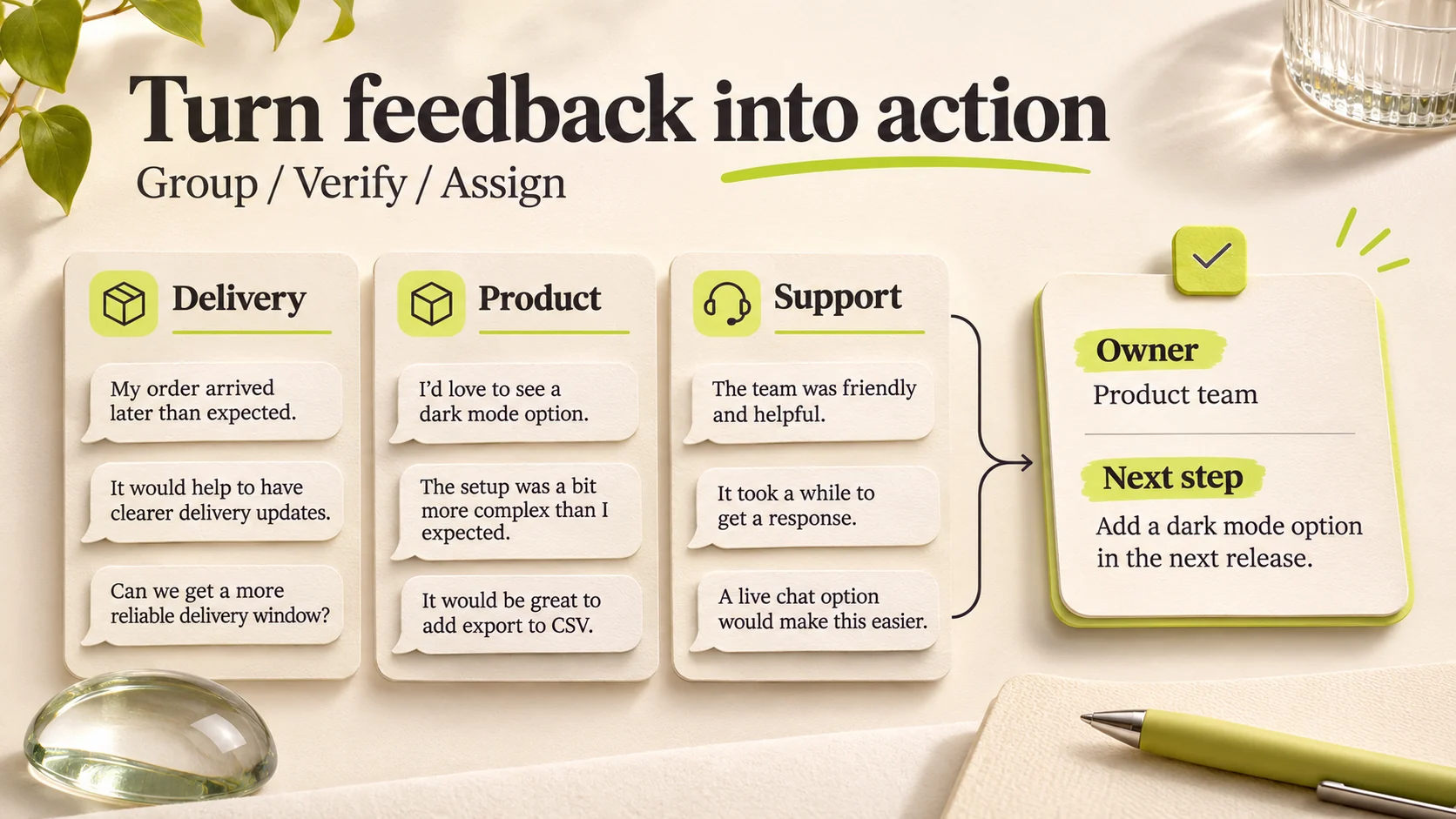
AI customer feedback analysis is useful when it helps a team find a recurring problem and assign a practical response. A dashboard full of positive and negative labels is not enough. The business needs to know what customers are describing, whether the pattern is real and who can investigate it.
Start with feedback you are entitled to process: support tickets, survey responses and permitted review exports. Record the source and period. These channels attract different kinds of response, so do not combine them into a single satisfaction score without a defensible method.
Separate topic, sentiment and consequence
A message can praise staff while criticising delivery. Microsoft distinguishes general sentiment analysis from opinion mining that connects opinions to particular aspects of a text. That distinction is useful even if you use a different provider: classify what the comment concerns, not just its emotional tone.
For each item, retain a source reference, relevant excerpt, topic, suggested urgency and uncertainty. Keep the model's interpretation distinguishable from the customer's words. A complaint about a payment screen is not proof that the payment system failed.
Create a reviewable theme list
- Remove duplicate records without erasing distinct customer experiences.
- Group related issues using a manageable topic vocabulary.
- Sample the underlying comments for each proposed theme.
- Separate reported symptoms from confirmed root causes.
- Assign an investigation owner and next action.
- Review later feedback after the action is completed.
Allow a comment to belong to more than one theme. Force-fitting every message into one category can hide an operational connection, such as customers mentioning both confusing delivery estimates and repeated support contact.
Example: a misleading negative trend
Illustrative scenario: a retailer sees more negative delivery comments after inviting feedback from customers with delayed orders. The rise may reflect a change in who was surveyed, not a sudden deterioration across all orders. Keep the invitation method and denominator alongside the result.
Read representative comments before deciding on an action. If the common issue is unclear tracking language, changing the courier may not address it. Confirm the cause with operational records rather than treating the AI summary as a diagnosis.
Protect context and privacy
Remove unnecessary personal details before sending text to an analysis service. Keep access to raw tickets limited to people who need it. A public review and a private support conversation may have different handling requirements even when both describe the same product.
Do not fabricate customer quotations to make a report clearer. Use short authorised excerpts or labelled paraphrases linked to the original record. A summary should make evidence easier to inspect, not replace it.
Choose a modest first output
A weekly list of three verified themes, their supporting examples and assigned actions can be more useful than a large dashboard. Track whether the assigned investigation happened and whether later evidence supports improvement. Do not claim causation from a simple before-and-after sentiment change.
Review provider lifecycle information before building. Microsoft's current documentation notes a future retirement path for its older sentiment features; selecting a supported service matters as much as the initial classification demo.
Common questions
Can sentiment scores measure customer satisfaction?
They describe a model's interpretation of text. They are not automatically equivalent to a properly designed satisfaction measure.
Should every negative comment trigger an alert?
No. Define escalation by business consequence and verified criteria, with a review route for ambiguity.
Can AI identify the root cause?
It can suggest patterns and questions. Confirm causes using operational evidence and human investigation.
Sources and further reading
Continue with operational gap assessment, customer support workflow design.
Discuss your workflow
HINTX helps businesses connect practical operating needs with AI automation and software engineering. Explore our related service, or describe your current process and the problem you want to solve. A useful first discussion starts with your systems, constraints and intended outcome.
Research checked 24 November 2026. Examples are illustrative unless explicitly identified otherwise. Product capabilities and terms can change. The cover is an AI-generated editorial illustration, not a client screenshot or measured result.


Login to comment
To post a comment, you must be logged in. Please login. Login
Comments (0)