
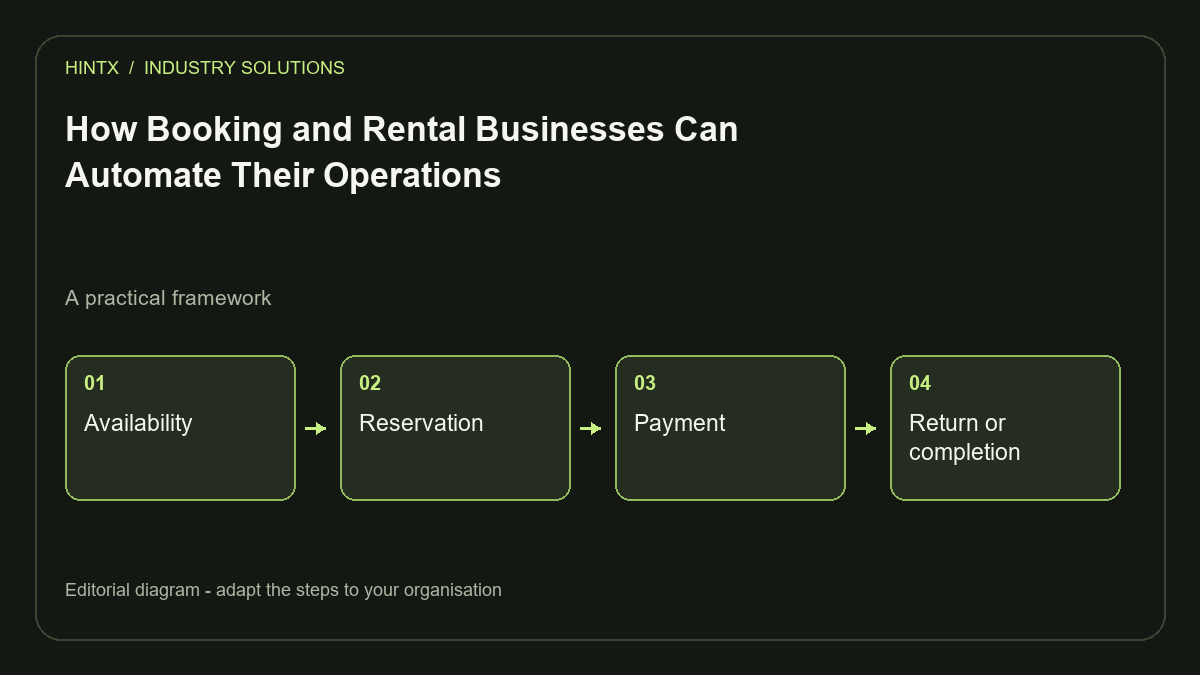
Booking and rental businesses can automate operations by connecting availability, reservations, payments, customer communication and resource status in one traceable workflow. Start with a reliable availability model. Then automate confirmations, staff tasks, returns and maintenance around it, while keeping exceptions visible to people.
A calendar alone is rarely the whole operation. A rental asset may need charging, cleaning, inspection or movement between locations before its next booking. A service appointment may depend on a qualified person and a suitable room. Automation must account for those constraints before promising availability.
Define what is actually being reserved
Distinguish named assets, interchangeable stock, staff time and capacity-based events. A customer reserving a particular vehicle differs from a customer booking one of several equivalent bicycles. A guided tour may require both participant capacity and an available guide.
Write down the resources and rules for each booking type. Include preparation and turnaround buffers, opening hours, location restrictions and maintenance blocks. Decide when a customer selects a specific asset and when allocation can happen later.
Google Calendar's Freebusy API provides busy time intervals. That can support a scheduling integration, but it does not itself model fleet condition, capacity or the full rental policy.
Separate availability checks from confirmed reservations
Two customers can see the same available slot before either completes checkout. The system must recheck and reserve capacity at the commitment point. A page that looked available several minutes ago is not sufficient authority to confirm a booking.
Use a deliberate hold policy where needed. A temporary hold should have an expiry, and abandoned checkout should release it. Decide how late payment confirmation interacts with an expired hold: a successful payment must not silently create an impossible reservation.
At the data layer, appropriate constraints and transactional logic protect against conflicting writes. PostgreSQL's constraints documentation includes exclusion constraints, one available mechanism for enforcing relationships such as non-overlap in a suitable design. The exact implementation depends on the database and resource model.
Model the complete lifecycle
| Stage | Automation opportunity | Required control |
|---|---|---|
| Enquiry | Capture dates and resource needs | Clarify incomplete requirements |
| Reservation | Hold or commit availability | Prevent conflicting allocation |
| Before arrival | Send reminders and staff preparation tasks | Use current booking details |
| Handover | Record asset and checklist completion | Confirm actual resource assignment |
| Return | Flag overdue items and create inspection tasks | Separate returned from ready to rent |
| Maintenance | Block resources and notify responsible staff | Require release after completion |
The state names should match the business. “Returned” may mean the asset is physically back; it should not automatically imply that it is safe, clean or charged for another customer.
A worked example: a small rental fleet
Consider an illustrative operator renting equipment from two locations. A booking needs an available unit, a collection slot and a turnaround buffer after return. Staff can substitute an equivalent unit, but the system records the actual asset handed over.
If a return is late, the workflow flags the affected next reservation and asks staff to reallocate or contact the customer. It should not keep advertising the same asset as available based solely on the original end time.
If an inspection identifies a fault, the unit moves into a maintenance state. The next reservation may still be fulfilled using another eligible unit. The customer-facing booking and the physical asset allocation are related records, not necessarily the same object.
Keep payment outcomes and reservation status aligned
Store payment references separately from booking states and record what each payment is for. A booking might involve an initial payment and later adjustments. Business rules should define what is required before confirmation or handover.
Stripe's webhook guidance documents asynchronous event delivery and duplicate handling. Build the integration so repeated notifications update the same payment and reservation records rather than sending conflicting confirmations.
Define a reconciliation queue for uncertain outcomes. Staff should be able to see a payment that succeeded while reservation confirmation failed. Avoid asking the customer to pay again until the original transaction has been checked.
Cancellation terms, deposits, identity checks and data retention need requirements appropriate to the business and jurisdiction. This article provides workflow design guidance, not legal or payment-compliance advice.
Automate useful communication
Send messages from current booking state. If the booking changes location, subsequent reminders should use the new location. Use stable message purposes so a replayed event does not send the same confirmation repeatedly.
Include information that reduces operational questions: collection time, required preparation, directions and a usable contact route. Avoid placing sensitive information into unnecessary channels. Record failed deliveries so staff can decide whether follow-up is needed.
Give staff one operational view of today's departures, returns, unresolved payments and unavailable resources. A manager should not need to compare several unrelated calendars to understand what requires attention.
Pilot the exception paths
- Two customers attempt to reserve the last available resource.
- A payment arrives after a temporary hold expires.
- A customer changes dates or location.
- An asset returns late or fails inspection.
- A calendar integration becomes unavailable.
- A confirmation message fails after the booking succeeds.
Measure administrative handling time, double-booking incidents, manual corrections, overdue work and unresolved exceptions. Compare equivalent operating periods and account for seasonal differences before attributing changes to automation.
Relevant HINTX work
HINTX's MiaFour portfolio describes rental, fleet and maintenance workflows. GoKosherTrip covers travel programme and booking operations. These establish relevant application scope without implying a measured improvement for every deployment.
Frequently asked questions
Can we keep our existing calendar?
Often, but define whether it owns availability or displays a copy. Conflicting sources of truth create difficult synchronisation problems.
Should every asset have its own calendar?
Not always. Interchangeable stock may be better represented as capacity with later allocation, while named resources need individual scheduling.
What should be automated first?
Start with accurate availability and a complete reservation record. Reminders are useful once the underlying booking information is trustworthy.
Does automation remove the need for staff judgement?
No. It can expose exceptions earlier and organise work, while staff decide how to handle circumstances outside agreed rules.
Explore HINTX software development or discuss your booking and rental workflow.


Login to comment
To post a comment, you must be logged in. Please login. Login
Comments (0)