
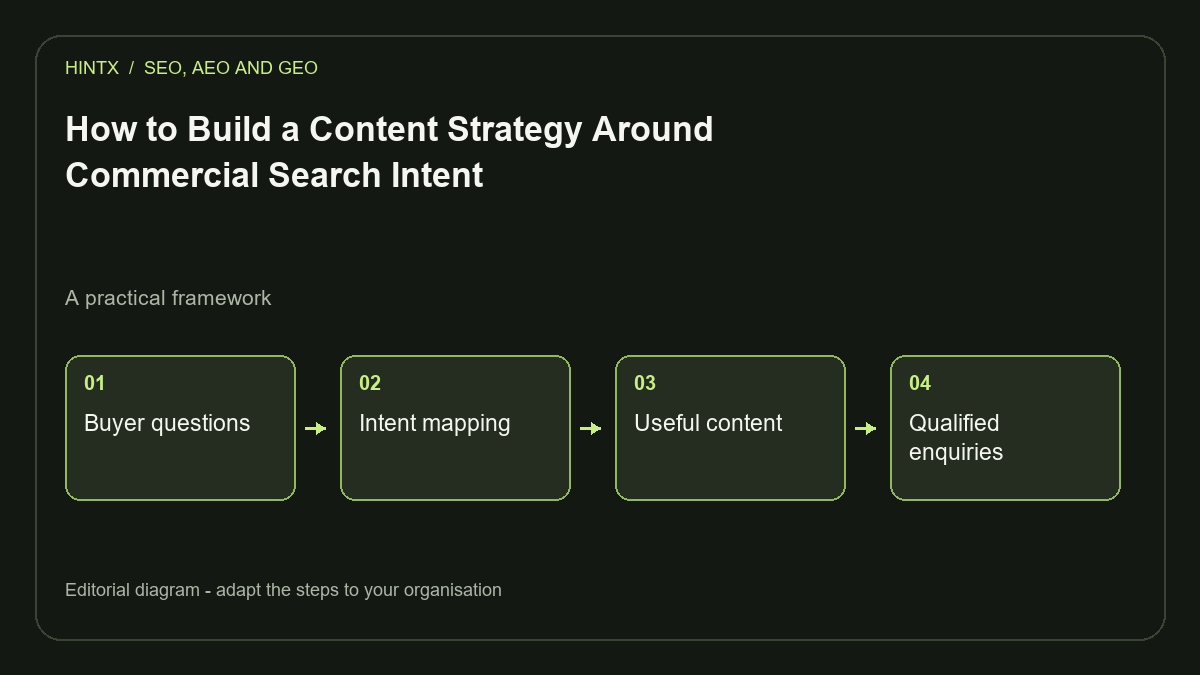
Build a commercial content strategy by matching a buyer's decision to the right page, then connecting that page to evidence and an appropriate next step. Begin with the problems your business can solve, validate the wording and intent with available data, and assign one primary page to each distinct search need.
Commercial intent does not mean every article must sell immediately. A buyer investigating disconnected ordering systems may need to understand integration risks before discussing a project. Useful content helps them make that decision while showing where your business can contribute.
Start with decisions instead of a keyword spreadsheet
List the decisions that precede an enquiry. A software buyer might ask whether to replace a tool, connect existing systems or build a custom application. They may then compare approaches, estimate the work involved and evaluate delivery partners. Each stage requires different evidence.
Ask sales and delivery teams for recurring questions, but keep customer information private. Record the underlying need rather than copying confidential messages into a public brief. Group questions by the decision they support, not simply by shared vocabulary.
| Buyer question | Useful page | Appropriate next step |
|---|---|---|
| Why are orders being re-entered? | Problem diagnosis guide | Map the current workflow |
| Should we integrate or replace the system? | Trade-off comparison | Review constraints |
| Can this team build a supplier portal? | Service page and relevant project | Discuss a scoped requirement |
| What information is needed for an estimate? | Discovery checklist | Prepare a project brief |
Collect evidence and label its limits
Google Search Console's Performance report provides query, page, country and device views. Use these to inspect the visibility your own site already receives. An impression is evidence of appearance for your site, not a complete measure of market demand.
Supplement this with observed search results, genuine buyer questions and existing project material. Record whether a keyword has measured data, a qualitative intent observation or only a working hypothesis. Do not assign invented volume or difficulty numbers to make the spreadsheet look complete.
For a UK-first programme, inspect UK-relevant language and buyer context. An article can be appropriate for UK businesses without inserting “UK” into every heading. Create separate country pages only when the offer, evidence or requirements justify distinct content.
Read the result format before choosing an article
Search a representative phrase and examine what the visible results offer: tutorials, vendor pages, comparisons, directories or product documentation. This does not reveal the entire audience, but it helps test whether your planned page matches the task.
If a query primarily seeks a provider, a useful service page may be the right destination. If it asks “how”, a detailed guide is often a better starting point. Mixed results can indicate mixed intent; choose a clear primary audience rather than forcing one page to perform every job.
Record the date and observed URLs so someone can review your interpretation later. Search results change. A content plan should be revisable when real query and enquiry data contradict the initial assumption.
Give each intent a clear home
A common planning failure is assigning the same main keyword to a service page, several articles and a location page without defining their roles. Instead, nominate a primary commercial destination, then give supporting articles distinct questions.
For example, the software service page can explain HINTX's delivery scope. An integration guide can explain how to assess disconnected systems. A project page can show relevant functionality. They share a theme while answering different needs.
Use descriptive internal links between them. Google's link guidance supports meaningful, crawlable links; editorially, the link should also explain why the destination helps the reader at that point.
Write briefs around evidence and decisions
A strong brief specifies the reader, question, direct answer, required examples, sources, internal destination and conversion action. It also lists claims the writer cannot make. If a project proves that an application was delivered but contains no measured savings, the article must not invent a percentage improvement.
Google's people-first content guidance is a useful editorial reference for originality and reliability. Apply it by adding analysis the business can defend: a decision table, a failure scenario or an implementation checklist.
Keep the example separate from experience. “Consider a distributor with three approval levels” introduces an illustration. “We reduced this distributor's approval time” is an outcome claim requiring evidence. The difference should remain visible to an ordinary reader.
Prioritise with a small scoring exercise
Score proposed topics against business fit, demonstrated buyer need, available evidence and the usefulness of the next step. Use a simple scale consistently; the result is a planning aid, not a prediction of rankings. A narrow topic with strong project evidence may deserve attention before a popular phrase outside your actual offer.
As an illustrative first release, a business could improve its software service page, publish an integration comparison and connect both to a relevant project. Review the resulting enquiries before expanding into loosely related topics. This produces a coherent path instead of an archive of isolated articles.
Measure the quality of the journey
- Track relevant landing-page visibility and visits.
- Review whether readers reach the linked service or project.
- Check that enquiry forms actually deliver usable submissions.
- Record fit, requested work and follow-up outcome in the sales process.
- Compare periods carefully and note other campaigns or website changes.
A rising traffic total can hide weak targeting. Conversely, a specialist page may bring few visits but support valuable conversations. Assess the content's role using both search evidence and business feedback.
Frequently asked questions
How many articles should we publish?
Start with the number you can research, review and maintain properly. Coverage of important decisions matters more than an arbitrary monthly quota.
Should every keyword get a separate page?
No. Closely related phrases often belong to one coherent page. Separate pages when the reader's task or necessary answer is meaningfully different.
Can we plan without paid keyword software?
Yes, using available first-party data and transparent qualitative research. State the limits and avoid pretending that observations are measured market volumes.
How should an article end?
Offer a next step that follows from the question answered: a requirements discussion, relevant project or service explanation. Avoid an unrelated sales pitch.
Explore HINTX's Digital Growth & Marketing Intelligence and Business Strategy & Growth Consulting services. Discuss a content plan built around your buyers' decisions.


Login to comment
To post a comment, you must be logged in. Please login. Login
Comments (0)