
AI automation + ecommerce software engineering
Druids: AI support, shopping and product workflows
AI-assisted customer support, voice shopping, virtual try-on and product workflows, with financial actions and sensitive cases handed to people.
ContributionAI workflow design, support integrations, Shopify experiences and internal product-system engineering; module-specific delivery evidence
View the product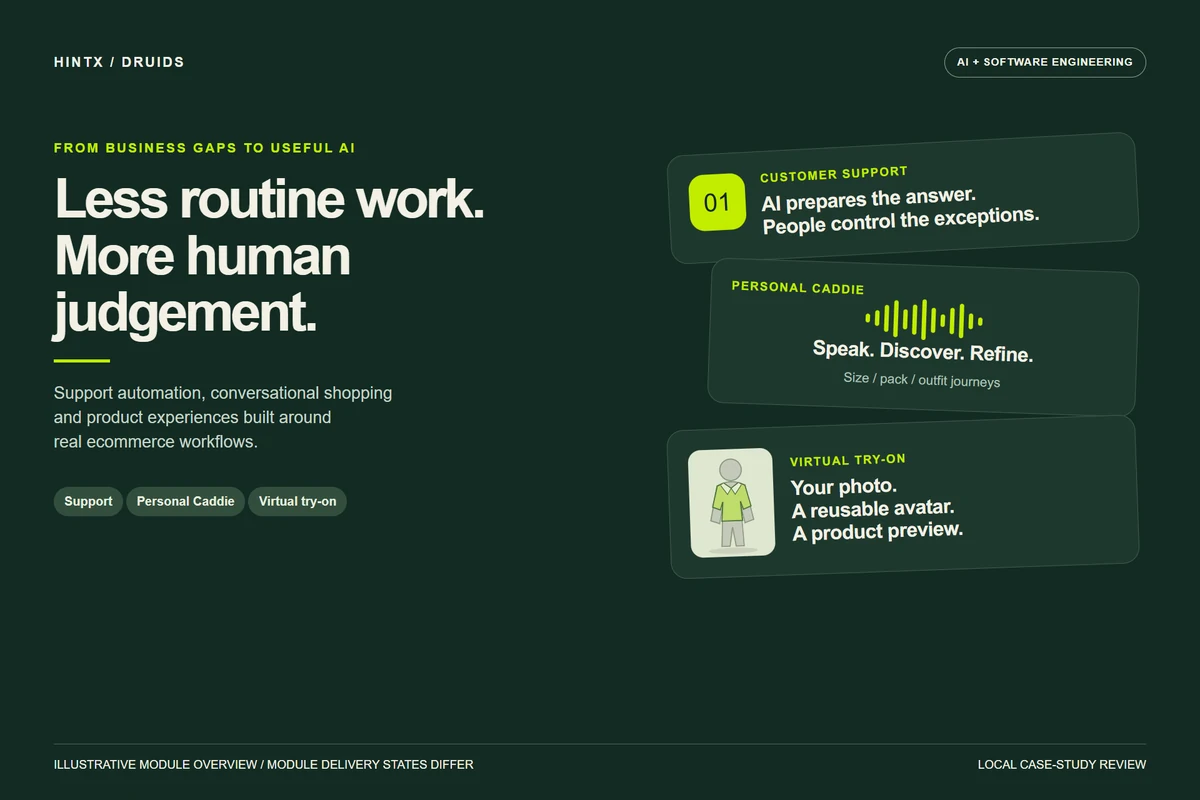
Find the business gap. Build the right AI workflow.
Druids brought together a Shopify storefront, a customer-support team, delivery partners and internal product and commercial teams. According to the owner, people were handling the support workload manually. The opportunity was to reduce repeated lookups and routine handling while keeping judgement, exceptions and financially significant decisions with people.
HINTX worked across support automation, conversational shopping, virtual try-on, product-development tools and operational integrations. Each module addressed a different gap; they were not one application or one simultaneous production launch.
Authentic screen compositions and explanatory mockups are labelled separately. Historical implementation, preview work and owner-reported outcomes are distinguished below.
01 / Customer support: from manual lookup to grounded assistance
The gap: a delivery or policy question could require staff to read a conversation, find the order, inspect tracking information and decide which rule applied. Repeating that process consumed attention that could be used for exceptions.
What HINTX built: AI-assisted support around existing Intercom conversations, Shopify order lookups, carrier information and policy evidence. The workflow interprets the request, retrieves the relevant facts and chooses between an authorised reply, a draft for review or a human handoff. It connects the tools already holding the information rather than inventing a parallel order system.
Where people stay in control: granting refunds, payment-related decisions, sensitive cases and unsupported actions are escalated. The automation is not authorised to refund, cancel or edit an order simply because a model proposes it. The intended benefit is less routine handling and more attention for cases needing judgement.
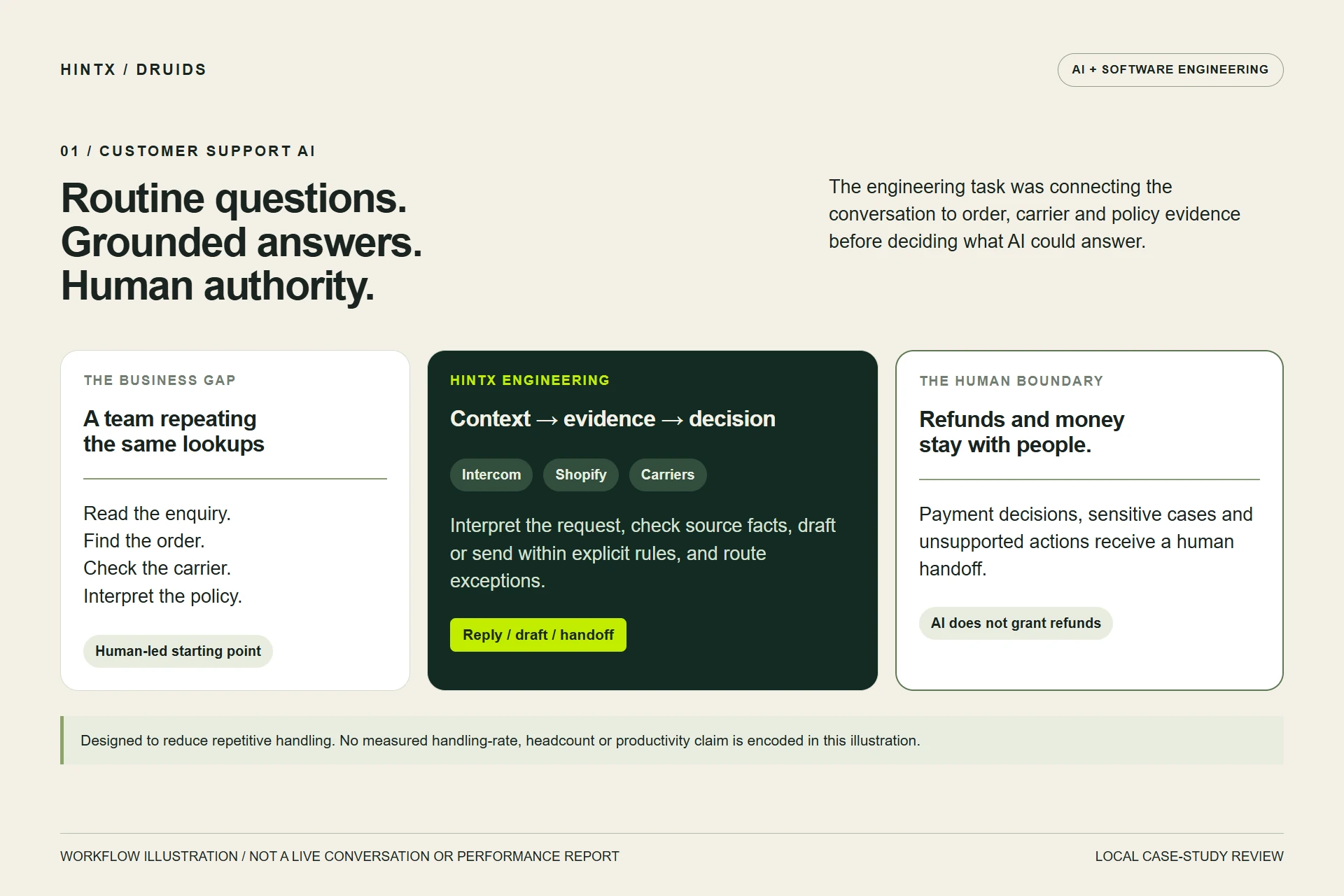
Illustrative support workflow based on the supplied engineering evidence. It explains context, source checks and human escalation; it is not a real conversation or a measured performance chart. Select the image to enlarge.
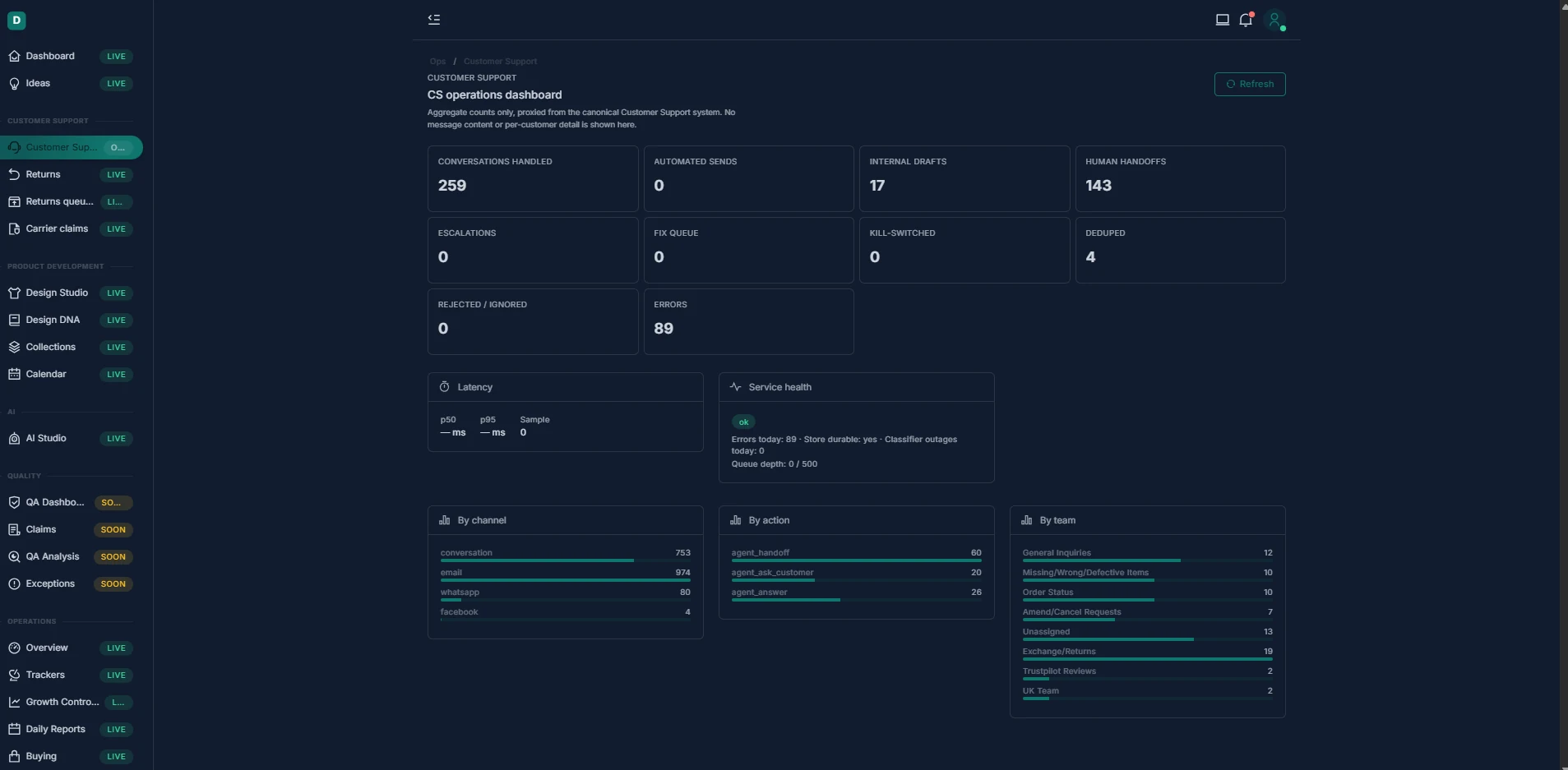
Delivery evidence: historical records describe implementation, channel controls and reported live-send configuration. The original evidence includes a restricted WhatsApp canary; later email and chat flags are reported in the independent review. Present-day channel coverage and outcomes have not been reverified. View the preserved authentic support-operations screen; its counters must not be treated as an automation-rate result.
02 / Personal Caddie: shopping through voice and conversation
The gap: a shopper may know the occasion, budget or look they want without knowing which products, sizes or combinations to choose. A catalogue alone does not provide that guided conversation.
The workstream: Personal Caddie was developed around voice and chat product discovery, with three defined journeys: find a size, build a pack and complete an outfit. The planned interaction lets a shopper refine colour, budget and product choices through a conversation, then review real product variants before cart and checkout.
The supplied roadmap assigns voice interaction to Vapi, live product search and details to Shopify Storefront MCP, and size/pack/outfit recommendation logic to a Node/TypeScript backend. Product names, prices and variants must come from Shopify; the assistant must not invent them. A cart update needs an actual Shopify acknowledgement.
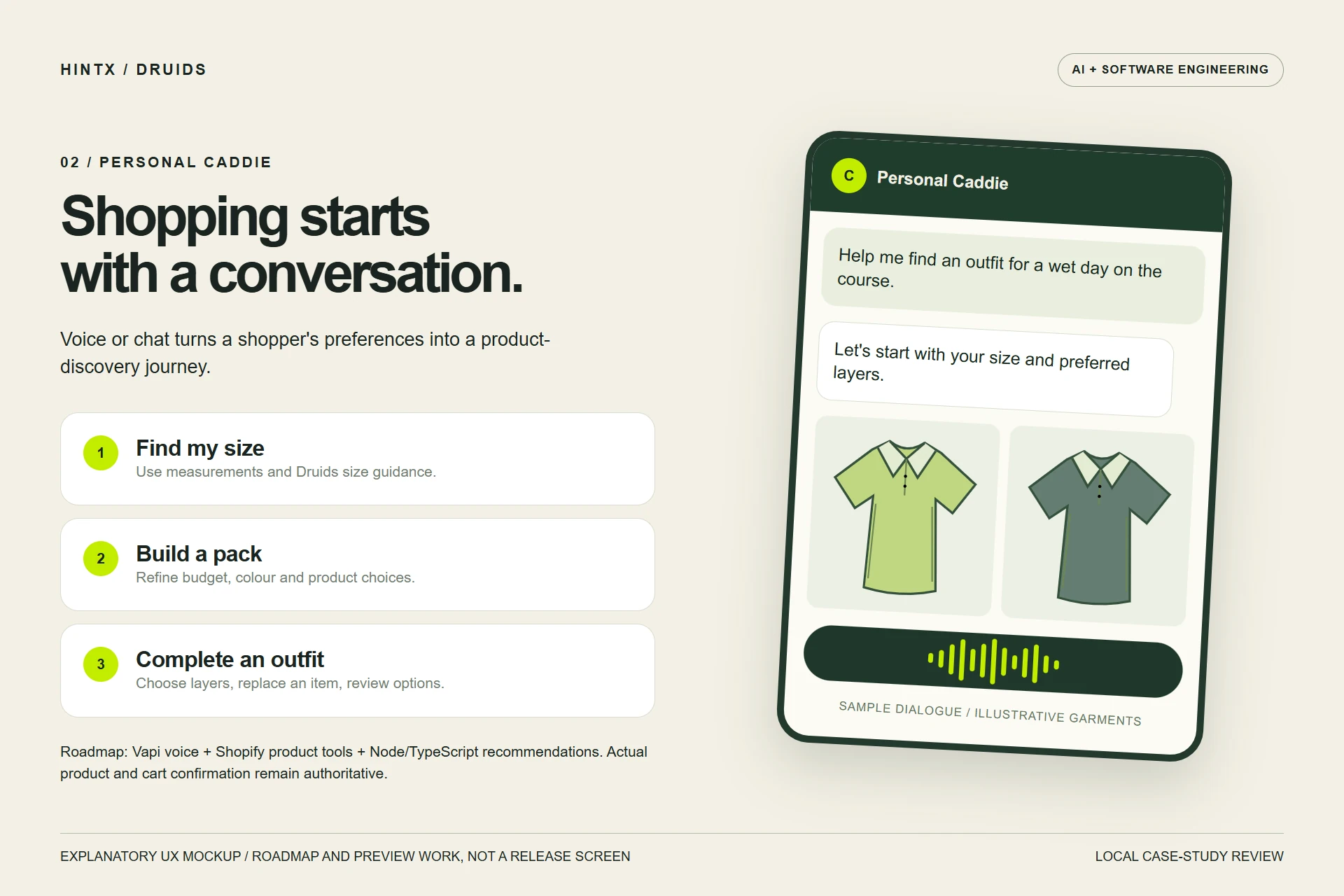
Explanatory Personal Caddie UX mockup. The dialogue and garment drawings are illustrative, not captured product UI, real catalogue recommendations or proof of a released voice/cart flow. Select the image to enlarge.
Delivery evidence: the eight-page roadmap defines the intended experience; it is not a release receipt. Supplied historical reviews document preview work and unresolved session/cart/voice acceptance issues at that checkpoint. The owner describes the assistant as built; a later accepted voice-to-cart recording or release record is still needed to establish the final delivered state.
03 / Virtual try-on: a product experience inside the storefront
The gap: shoppers can see product photography but may struggle to imagine a garment on themselves. A reusable avatar creates a way to explore that visual question within the shopping journey.
What HINTX built and documented: a separate virtual fitting-room service with a Shopify product-page launcher. The supplied September 2026 guide describes one uploaded photo becoming a reusable full-body avatar, then showing that avatar wearing selected Druids products. A full-screen overlay opens above the product page, without an iframe or redirect.
Shopify supplies the product-page context. The fitting-room service handles the photo, avatar, catalogue, wardrobe, sizing and generated images. The guide also specifies unsupported-product messages, generation-allowance handling and restoration of page focus/scrolling when the overlay closes. These are part of the integration, not decorative UI details.
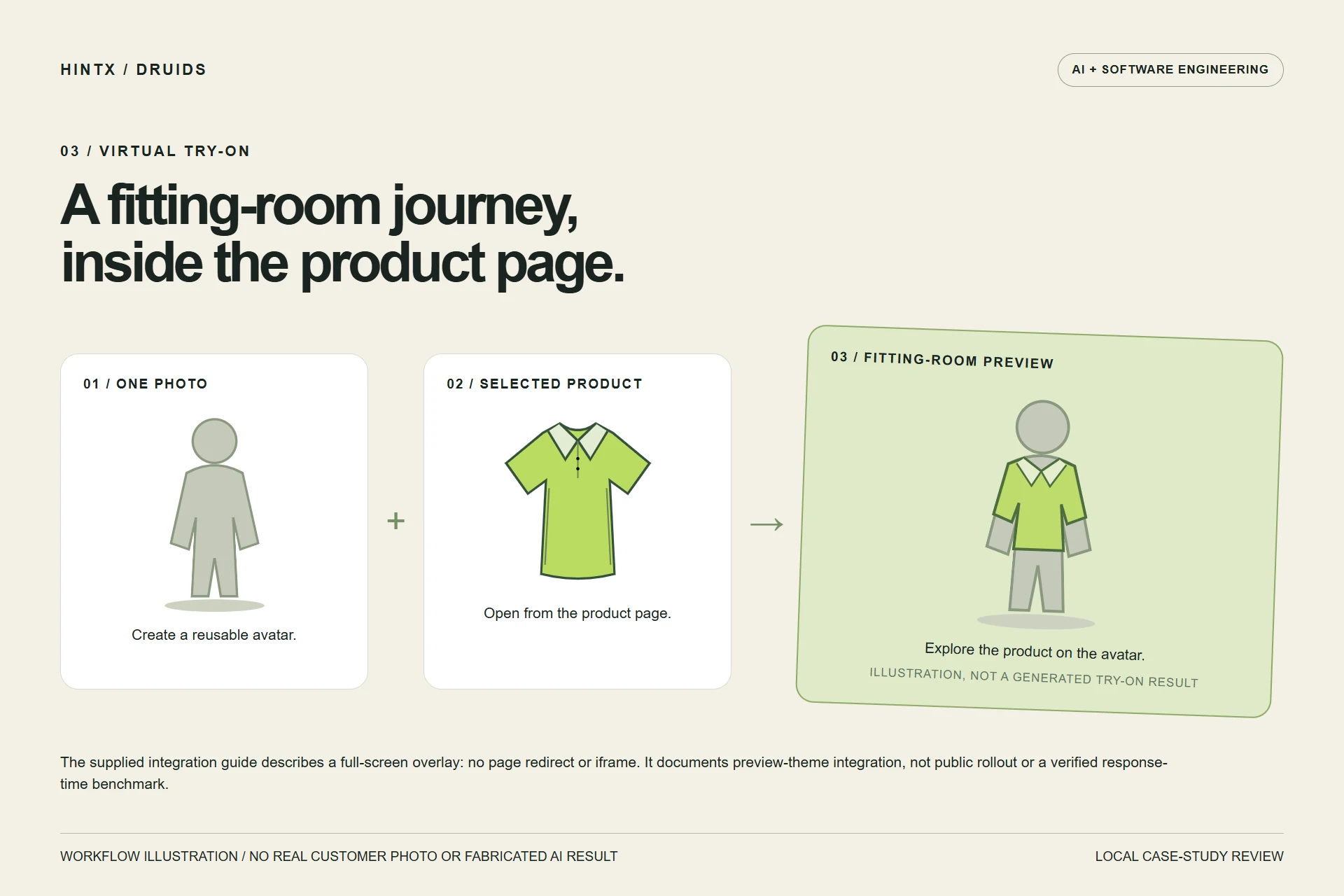
Illustrative virtual try-on journey based on the supplied integration guide. Anonymous drawn figures explain photo, avatar and product preview; this is not a real customer photo or an actual generated try-on result. Select the image to enlarge.
Delivery evidence: the two-page guide describes a historically deployed standalone service and preview-theme integration. It explicitly reserves public storefront launch for a separate decision. An authorised before/after fitting-room capture and timed generation trace are still missing from this portfolio package.
04 / Design Studio: make product-development stages visible
The gap: ideas, references, briefs and visual explorations need an orderly handoff. An AI-generated concept should not silently become an approved manufacturing specification.
HINTX's contribution: early Opportunity, Brief and Looks workflows, a Design DNA reference library and stage-specific review controls. The supplied board shows the actual working interface; empty stages remain empty in the visual. Tech Pack, Quotes and Sample foundations are not presented as an accepted end-to-end manufacturing workflow.
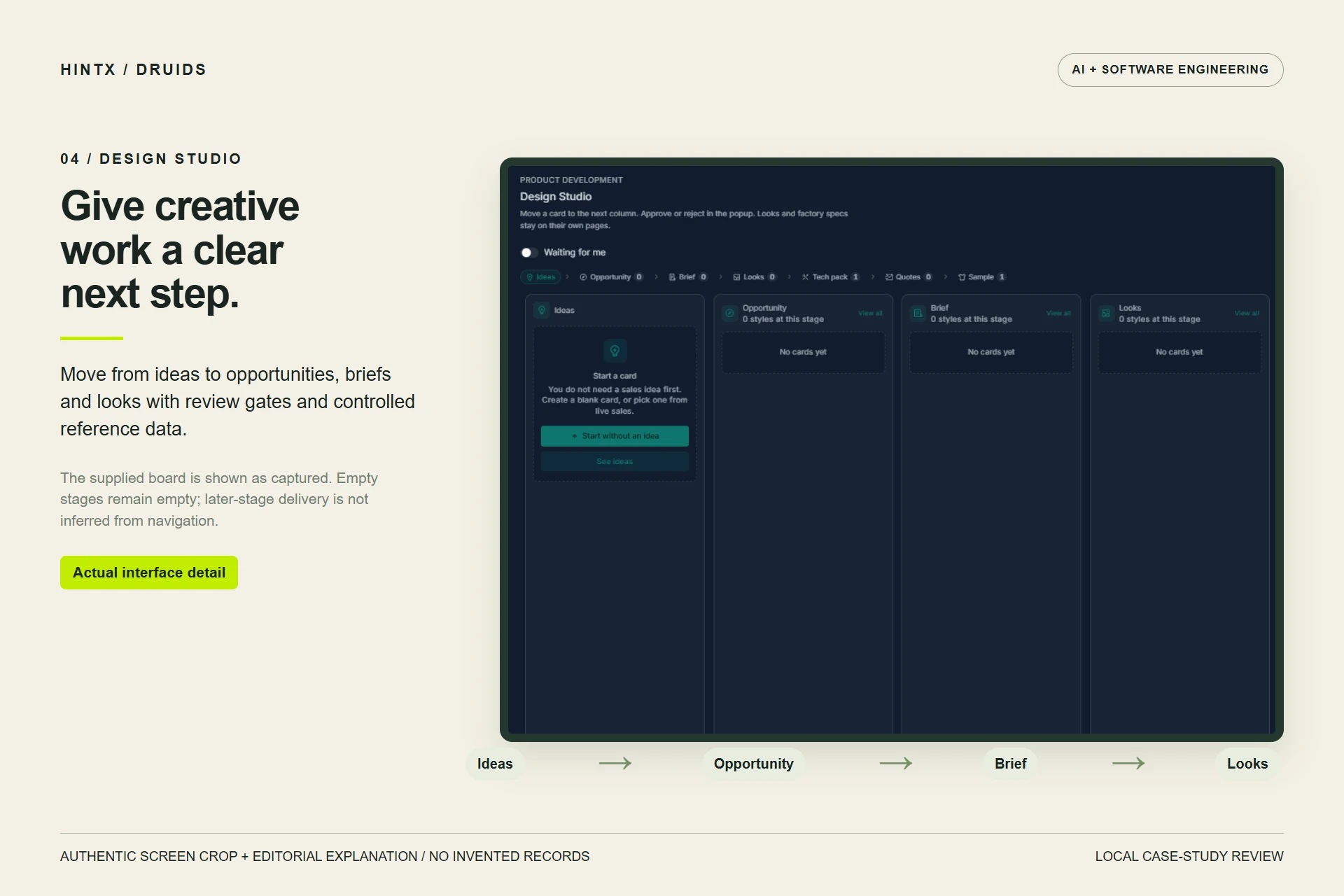
Authentic Design Studio screen crop in a new editorial composition. The UI and its empty stages are preserved; surrounding labels explain the workflow and do not add application features. Select the image to enlarge.
05 / AI creative tools: a workspace for product imagery
The supplied AI image-workspace capture shows product selection and a generation workspace within the internal portal. HINTX's role included connecting AI-assisted creative work to the product-development environment. Generated concepts and assets still require human review for usefulness, accuracy and rights; a visible tool is not evidence of approved manufacturing output or measured productivity.
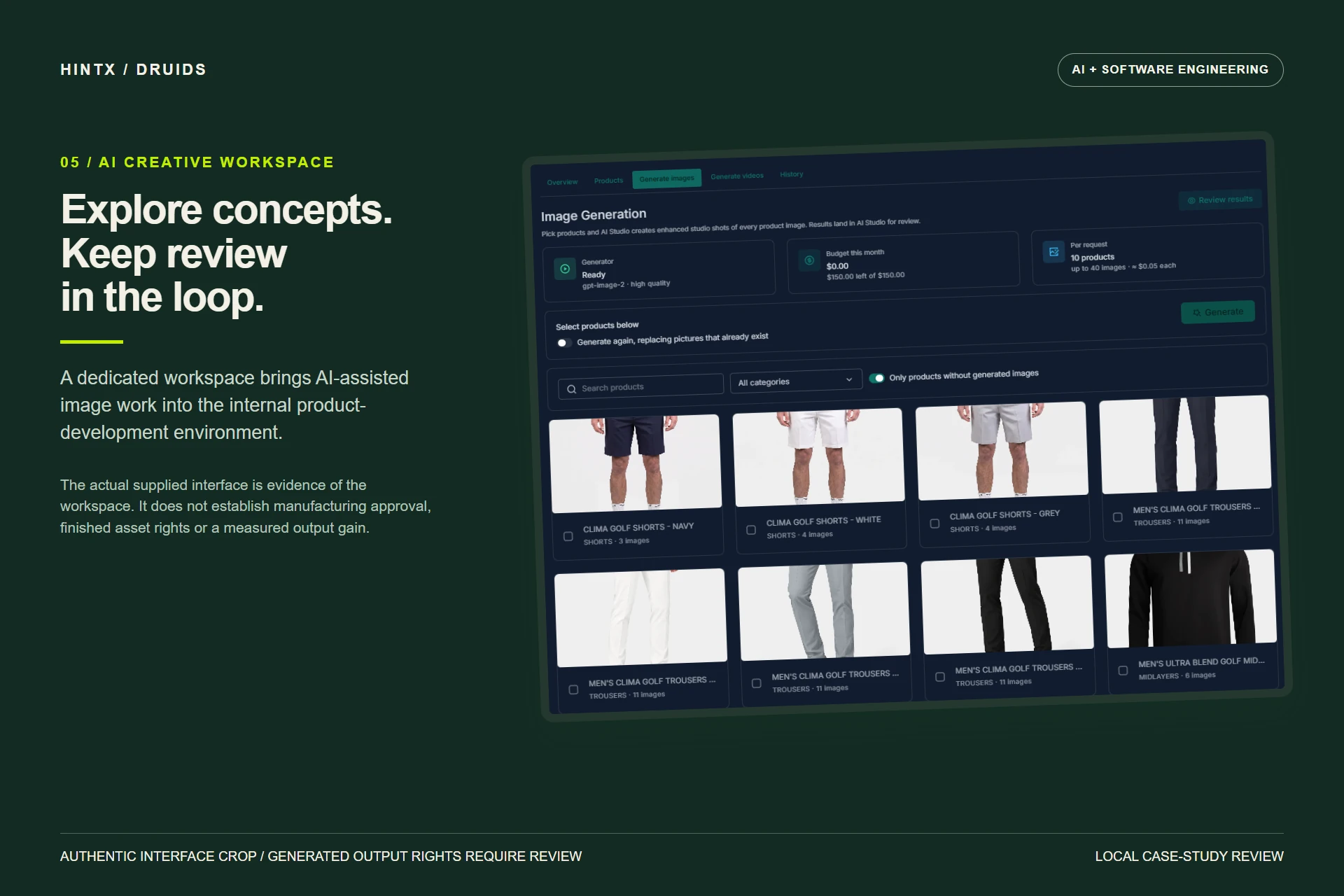
Authentic AI creative-workspace crop, reframed for legibility. No product records, output examples, controls or performance figures were generated for this portfolio image. Select the image to enlarge.
06 / Commercial and returns workflows: connect the business safely
HINTX also worked on commercial reporting and operational integrations: reconciling sales/refund information, showing incomplete source coverage and placing approval around estimated margins. A dated 24 September 2026 record describes a specific Commercial V2 production release. That work is distinct from the separately client-built Growth Control Centre identified in the independent review; the portfolio does not claim ownership of the client's tool.
The Returns Portal work explored policy checks, case preparation and human handoff. The evidenced UK Phase 1 state was DRY_RUN. No live autonomous refund, global carrier-label rollout or recovered compensation is claimed. Shopify, Intercom, the staff portal and specialist services retain their separate responsibilities.
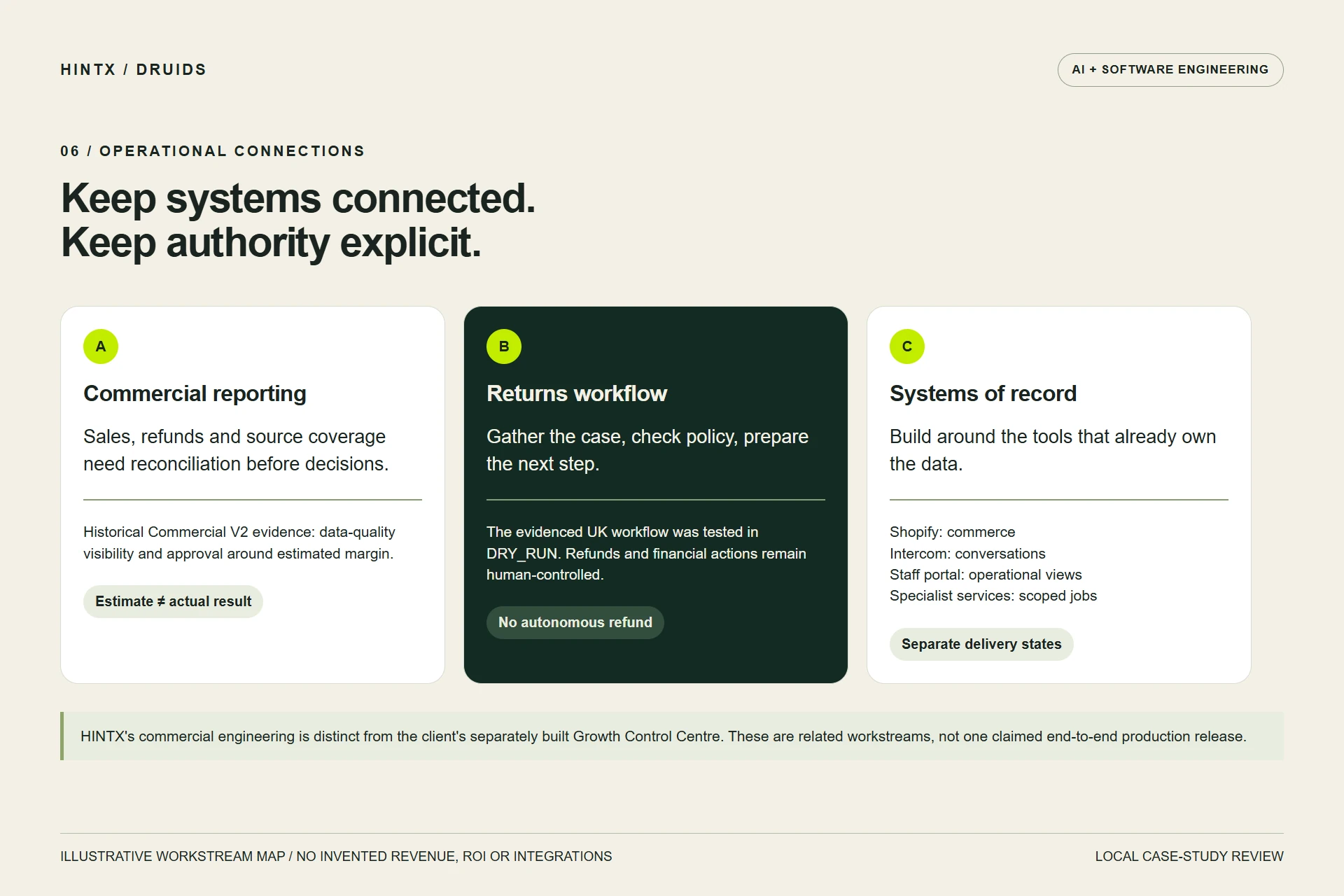
Illustrative operational workstream map. Commercial V2 history, separate client-built Growth Control Centre ownership and Returns DRY_RUN boundaries remain explicit; this is not a current production topology. Select the image to enlarge.
Outcome claims and the remaining evidence
The engineering story is a move from repeated manual work toward connected, evidence-aware assistance, guided shopping and reviewed product workflows. Improving productivity was the purpose; the supplied evidence does not quantify a business-wide productivity gain.
Owner-reported figures for review, not verified portfolio results: the owner reports that AI could handle approximately 90% of the work and that try-on images were produced in under 10 seconds. The period, workload definition, denominator, exceptions and timing conditions are not supplied. Earlier support reports measure different concepts and periods. These figures are retained here as local review notes, not used in the headline, artwork, SEO metadata or a public performance guarantee.
- Support: provide a dated handling-rate definition and representative logs showing autonomous resolution versus drafts or human-assisted work.
- Caddie: provide a clean voice/chat journey through real product selection and confirmed cart changes, plus the final accepted release state.
- Try-on: provide consented input/output captures, generation timings and confirmation of the storefront rollout.
- Commercial and creative modules: provide approved screenshots, exact contribution attribution and client/visual publication permission.
Related engineering services
Business workflow automation · Voice AI and conversational systems · Custom business software
AI + software engineering
Make your systems work together.
Tell us about the workflow, the people using it and the constraints that matter.
Discuss your project