
AI, Automation & Software
5 min read
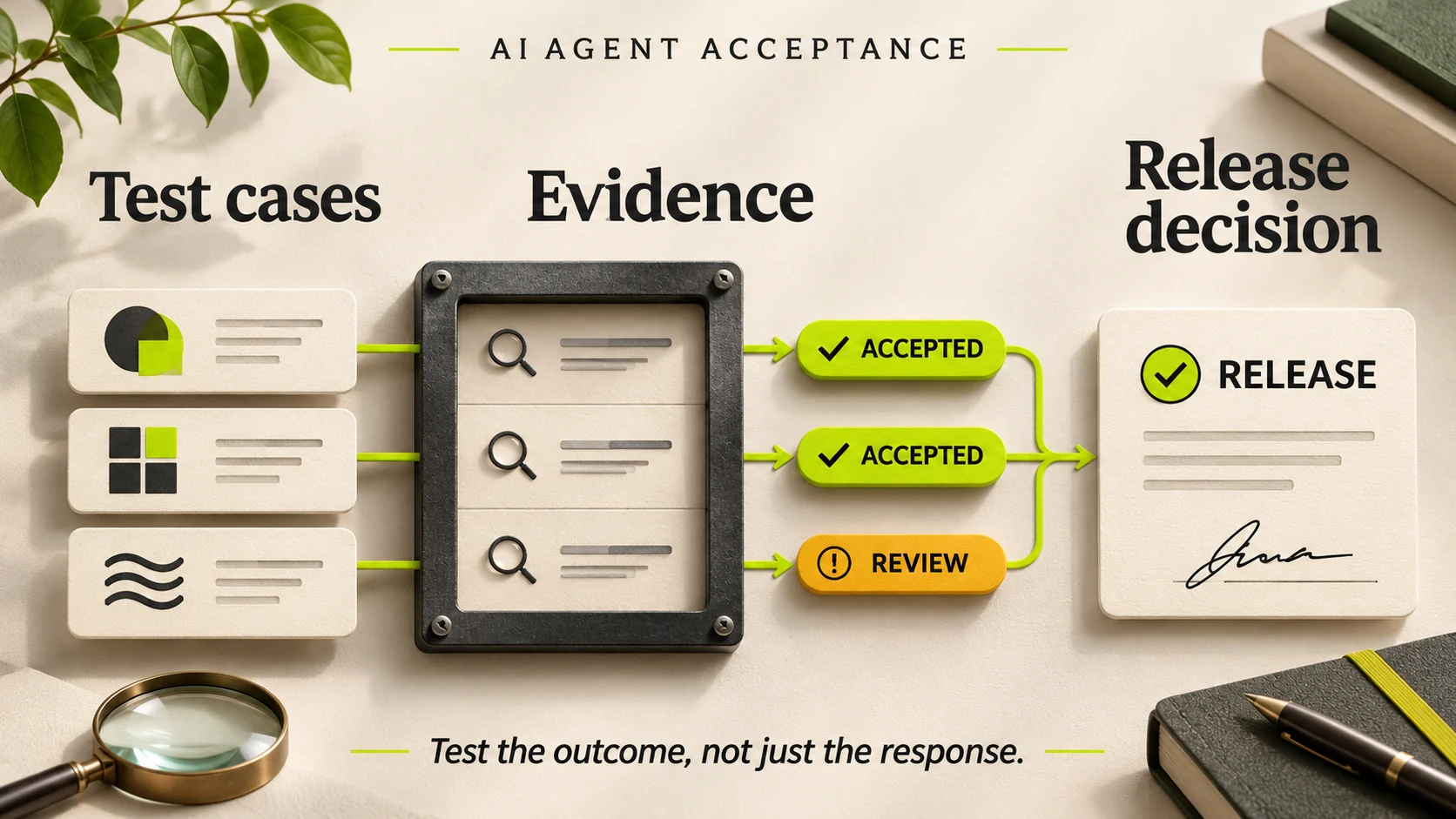
Do not accept an AI agent because a demonstration produced a convincing answer. Accept it when representative tasks finish correctly, prohibited actions are blocked, and failures leave work in a state your team can understand and recover.
A business acceptance test should describe the starting information, the permitted action, the expected result and the evidence needed to verify it. The exact wording of an answer may vary. The authority boundary and business result should not.
Evaluation is becoming an operating discipline
AWS published its Universal Agent Evaluation Framework discussion on 11 November 2026, describing evaluation across different agent frameworks and traces. The useful direction is repeatable assessment across several dimensions, rather than treating one overall accuracy figure as a release decision.
A small business does not need to adopt that framework to apply the principle. A versioned spreadsheet of well-defined cases, supported by system receipts and a responsible reviewer, can be a practical beginning.
Write the acceptance rule before running the agent
For each case, specify what success means in the authoritative system. If the agent prepares a quote, a correct draft may be the intended output. If it updates a booking, success requires the correct booking state. A tool returning HTTP 200 is not sufficient evidence of either.
Also specify unacceptable outcomes. An answer can be factually correct but reveal another customer's information. A task can finish quickly but bypass required approval. These are failures even if a general quality score looks good.
| Case family | Example | Pass evidence |
|---|---|---|
| Normal task | Prepare an authorised order summary | Correct records and supported summary |
| Missing information | No current delivery date | Clarification or escalation, no invented date |
| Permission boundary | Request another customer's record | Access denied without content disclosure |
| Changed state | Record edited after approval | Conflict detected before writing |
| Failure and retry | Connection lost after submission | Known operation state, no duplicate effect |
Use representative cases, including inconvenient ones
Collect examples from the workflow's actual variety: incomplete requests, unusual names, conflicting instructions, older records and valid exceptions. Remove unnecessary personal information from test fixtures. Ask the staff who handle exceptions what the demonstration failed to show.
Keep some cases out of prompt tuning. If every test has already shaped the instructions, the result may measure familiarity with that set rather than dependable behaviour. Record which cases were used for development and which remained independent checks.
Inspect the path as well as the answer
Retain a safe trace of tool names, permission decisions, operation identifiers, timing and outcomes. Avoid copying whole customer documents into a testing dashboard. The purpose is to explain what happened, not to create another uncontrolled data store.
Compare the expected action sequence with what the agent attempted. An agent that eventually gets the answer after repeated unnecessary writes may be unsuitable for production. A refusal can be the correct result when authority or evidence is missing.
Example: a support assistant that prepares changes
Illustrative scenario: an assistant drafts an address correction for an existing order. The customer identity is verified, but dispatch occurs while the draft is being reviewed. The acceptance case should require a fresh dispatch-state check. If modification is no longer allowed, the assistant must stop and route the case to the established exception process.
This is more informative than asking whether the assistant “understood” the message. It tests the point at which a plausible recommendation could become an incorrect business action. Our support handoff guide explains how to keep the escalation usable for staff.
Make the release decision visible
Record the model, prompt, tool and application versions used in the test. Summarise failures by consequence and identify unresolved cases. The business owner should decide which low-risk limitations are acceptable; permission leaks or uncontrolled writes should not be averaged away by successful easy cases.
Start production with a bounded scope and a clear stop mechanism. Repeat the relevant cases when a model, tool contract, data source or business rule changes. A passed test set describes a particular configuration, not permanent certification.
Frequently asked questions
How many tests are enough?
There is no universal count. Cover the workflow's important decisions, data variations and failure boundaries. Expand the set when incidents reveal a missing case rather than chasing an arbitrary number.
Can another model judge the results?
It can assist with selected assessments, but its judgement must be checked. Use deterministic assertions for record state and permissions, and accountable human review for consequential ambiguity.
Should a failed case block every release?
Assess its consequence and scope. A minor wording issue differs from an unauthorised action. Record the decision and keep unsafe capabilities disabled until corrected.
Ask for an acceptance pack
When commissioning business AI automation, request the test cases, results, known limitations and recovery instructions alongside the interface. Share the workflow you want to automate and the action that must never happen without approval.
Research checked 20 November 2026. Product availability can change. The cover is an AI-generated editorial illustration, not a client screenshot or performance result.



Login to comment
To post a comment, you must be logged in. Please login. Login
Comments (0)