
Business Strategy
4 min read
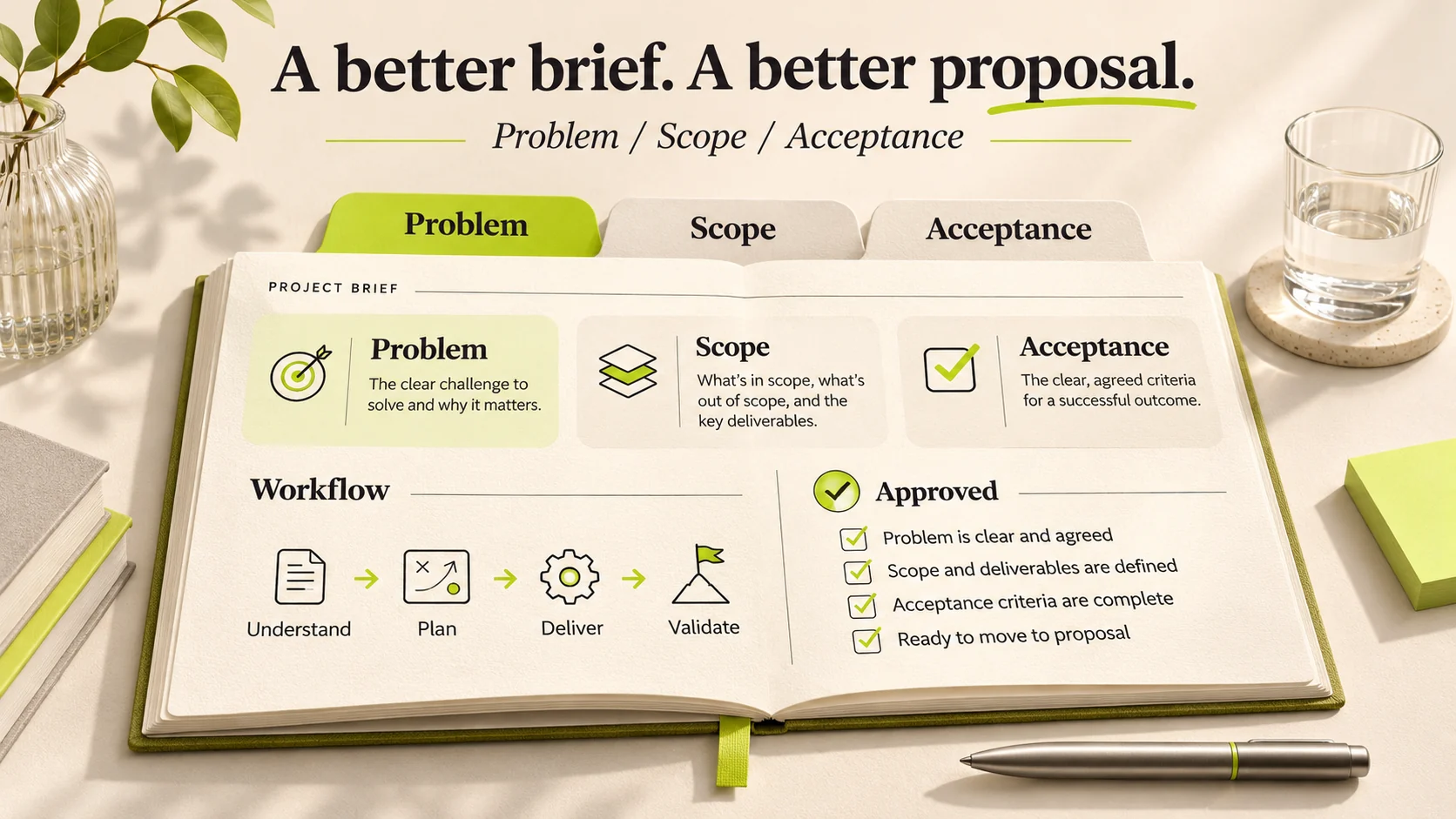
A useful AI automation project brief explains the work that needs to change and the conditions a solution must satisfy. It does not need to prescribe a model or contain a long list of fashionable features. Suppliers can propose better options when the business problem and constraints are clear.
Write the brief around one workflow. “Automate our business” is difficult to estimate. “Reduce manual copying between approved orders and the fulfilment system while preserving exception review” gives a team something concrete to assess.
A brief you can adapt
- Problem: what currently happens, who performs it and why it causes difficulty.
- Outcome: the observable improvement you want to evaluate.
- Workflow: trigger, inputs, decisions, actions and completion state.
- Systems: applications, owners and known integration access.
- Authority: what can happen automatically and what needs approval.
- Exceptions: missing data, disputes, outages and unusual cases.
- Acceptance: examples that demonstrate a correct result.
- Operations: monitoring, support, handover and manual fallback.
Use evidence where available: anonymised work examples, process timings and the frequency of a particular error. If the baseline is unknown, say so and include measurement in discovery. Do not fill the brief with a desired percentage saving presented as an established fact.
Show normal work and difficult cases
Provide a small representative sample. For enquiry qualification, include a complete request, an existing customer, an ambiguous message and a duplicate. State what a good result looks like for each. This makes proposals easier to compare and creates the basis for acceptance testing.
Describe information that must remain private and actions the system must never take without approval. Avoid sending credentials or unnecessary customer data with a procurement brief. Access can be arranged through an appropriate controlled process later.
Example: support automation with refund boundaries
Illustrative scenario: a retailer wants an assistant to answer order questions and prepare return requests. The brief names the commerce platform, permitted lookup fields and customer verification process. It explicitly reserves refund execution for an authorised person and includes an example where a customer asks the assistant to bypass that rule.
The proposal should explain the conversation flow, integration, approval and recovery path. A demo that answers product questions but cannot handle the specified return case is not sufficient evidence of fit.
Ask suppliers to expose assumptions
Request separate estimates for discovery, implementation and ongoing operation. Ask which integrations and account plans are assumed. Published platform documentation, such as Copilot Studio's overview, helps frame possibilities, but the supplier should verify the exact capabilities needed in your environment.
Require a list of exclusions and unresolved questions. This is useful information, not a weakness to hide. A supplier who identifies missing access early may prevent a costly misunderstanding later.
Define review and change control
Name the process owner and the person who can approve scope changes. Agree how demonstrations will be reviewed and how new requests affect the plan. Keep the accepted brief and subsequent decisions together so the team does not rely on scattered chat messages.
Include a handover outcome: documentation, access ownership, recovery instructions and a demonstration that your team can operate the delivered workflow. A finished build is not the same as an adopted business process.
Common questions
Must we choose the AI model first?
No. Define the task, constraints and acceptance criteria first. Model selection should support those requirements.
How long should the brief be?
Long enough to make the workflow and decisions clear. A concise brief with representative examples is better than many pages of generic aspirations.
Can discovery be a separate phase?
Yes. Where access, data or process details are uncertain, a bounded discovery phase can produce a reliable implementation scope.
Sources and further reading
Continue with business process assessment, AI agent acceptance criteria.
Discuss your workflow
HINTX helps businesses connect practical operating needs with AI automation and software engineering. Explore our related service, or describe your current process and the problem you want to solve. A useful first discussion starts with your systems, constraints and intended outcome.
Research checked 24 November 2026. Examples are illustrative unless explicitly identified otherwise. Product capabilities and terms can change. The cover is an AI-generated editorial illustration, not a client screenshot or measured result.



Login to comment
To post a comment, you must be logged in. Please login. Login
Comments (0)