
Business Strategy
5 min read
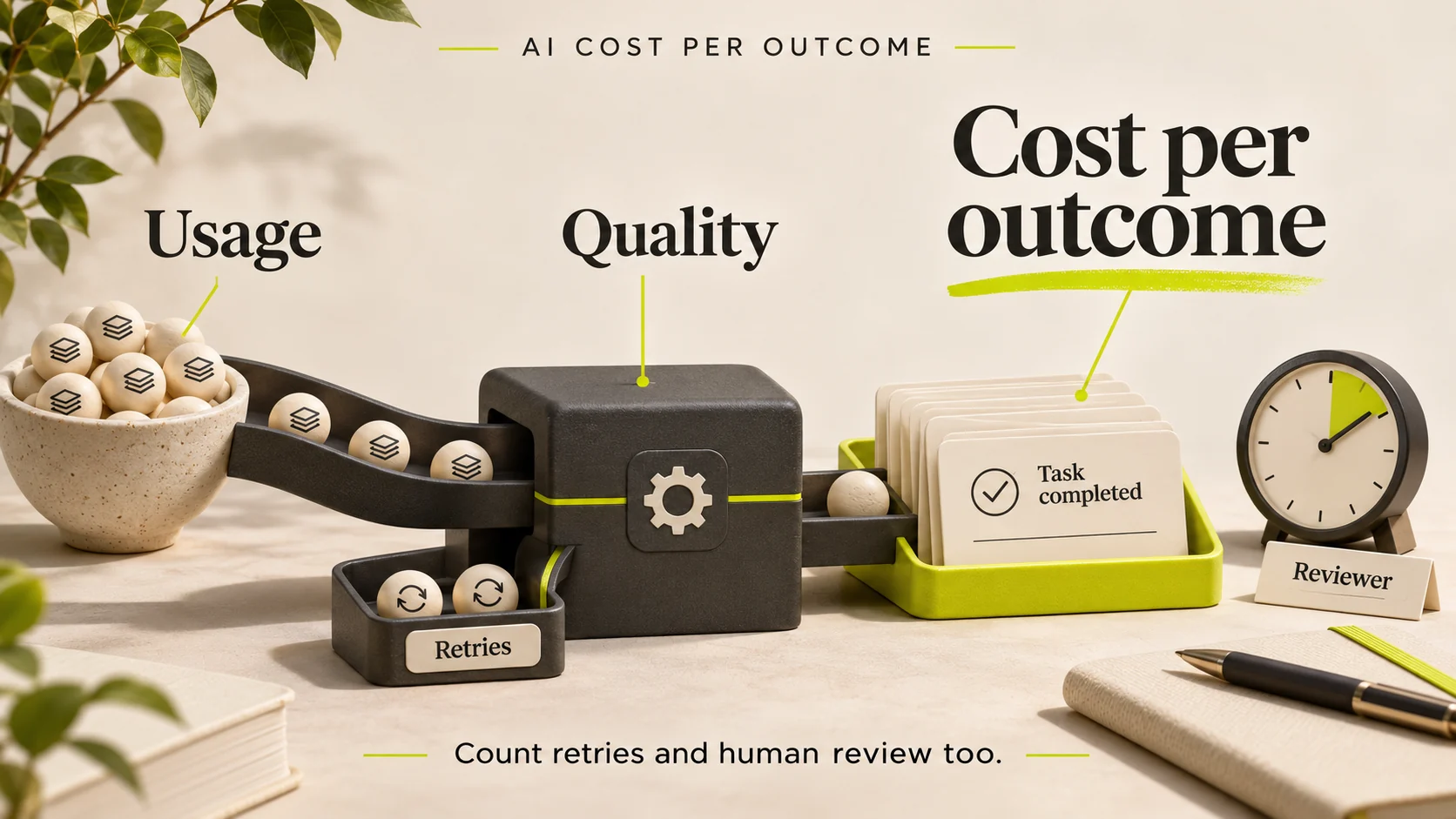
Measure AI operating cost against work your business accepts as complete. Token prices are one input. Retries, retrieval, tools, infrastructure and human review can matter just as much.
A cheaper model call can be more expensive if it creates more corrections. A premium model can be unnecessary for a simple classification task. Compare complete workflows using the same quality and authority requirements.
Why model routing is now a practical business question
AWS published a self-service LLM gateway example on 12 November 2026, covering central access and operating controls. A gateway is one implementation option for organisations managing several model paths; it is not infrastructure every small business needs.
The underlying decision is simpler: know which task uses which model, who can change that route and what the accepted result costs. Start with that visibility before building a new platform.
Define the unit of useful work
Choose a unit such as an accepted document extraction, a reviewed support draft or a completed authorised record update. Avoid counting every generated answer as a successful outcome. A task that is retried three times is still one task, and an unresolved task should remain unresolved in the report.
Keep quality and authority requirements stable across the comparison. Reducing cost by skipping a required review or using less complete evidence changes the service being measured.
| Cost component | What to record | Common omission |
|---|---|---|
| Model usage | Actual billable usage by route | Retries and long context |
| Retrieval and tools | Search, storage and external calls | Failed or repeated calls |
| Infrastructure | Allocated operating cost | Idle capacity and monitoring |
| Human review | Review and correction time | Exception handling |
| Maintenance | Updates and incident work | Ongoing ownership after launch |
A simple calculation with honest boundaries
For an agreed period, divide the relevant operating costs by the number of accepted completed tasks. Show the numerator and denominator, the period and any excluded costs. Keep failed-task costs in the numerator so a weak workflow does not appear cheap by discarding its failures.
Illustrative calculation, not HINTX or provider pricing: suppose model, tool and infrastructure costs total 120 units, while review and correction cost 180 units. If 100 tasks are accepted, the measured operating cost is 3 units per accepted task. A route costing less in model usage can still lose that comparison if it substantially increases review work.
This does not establish return on investment. A business case also needs a credible comparison with the existing process, useful capacity released, implementation cost and ongoing obligations.
Route by task requirements
Separate simple, well-defined tasks from ambiguous or consequential ones. A small classifier may route a document type, while a more capable model handles a complex explanation. Deterministic validation should still check required fields and business rules.
Do not route sensitive data to a different provider merely because the first service is unavailable. Every fallback path needs an approved data boundary and acceptance evidence. The private deployment guide covers that architecture decision.
Put limits around repeated work
Set a maximum number of retries, tool calls or delegation steps appropriate to the task. When the limit is reached, return a clear unresolved state and a human handoff. An agent that repeatedly rephrases an impossible request can consume budget without making progress.
Use operation identifiers to avoid repeating a completed external action. Track whether a retry was caused by a model decision, a provider error or an application fault. Those causes need different fixes and should not disappear into one usage total.
Example: two routes for document review
Illustrative scenario: an operations team compares two extraction routes on the same representative documents. One has lower model cost but produces more unclear fields. The other costs more per call but reduces the number of cases requiring correction. The team measures accepted fields, exception handling and reviewer time before choosing a route.
The decision may differ by document type. Clean digital documents and damaged scans should not automatically share the same route. Keep enough detail to see that difference without turning the report into a collection of uninterpretable metrics.
Review the budget with the service owner
Agree alert thresholds and the action each alert should trigger. A usage spike might be legitimate demand, a loop or abuse. Automatically disabling a critical workflow can have consequences, so define which tasks can pause and which need a controlled fallback.
Maintain a record of model and prompt changes alongside cost observations. A later comparison is meaningful only when the service delivered and the measurement method are understood.
Frequently asked questions
Can we estimate cost before launch?
Yes, using a representative test set and explicit assumptions. Treat the result as a range to validate in operation, not a guaranteed monthly bill.
Should every task use the cheapest model?
No. Select a route that meets the task's quality, data and authority requirements, then compare total operating cost among acceptable options.
Is a gateway necessary?
Not always. A small integration may need only clear configuration, usage records and limits. Add shared infrastructure when actual operating needs justify it.
Build a business case around completed work
HINTX's business strategy service and automation implementation connect operating requirements with software decisions. Bring one workflow and its current effort or cost evidence to define a useful pilot comparison.
Research checked 20 November 2026. Product availability can change. The cover is an AI-generated editorial illustration, not a client screenshot or performance result.



Login to comment
To post a comment, you must be logged in. Please login. Login
Comments (0)