
AI, Automation & Software
4 min read
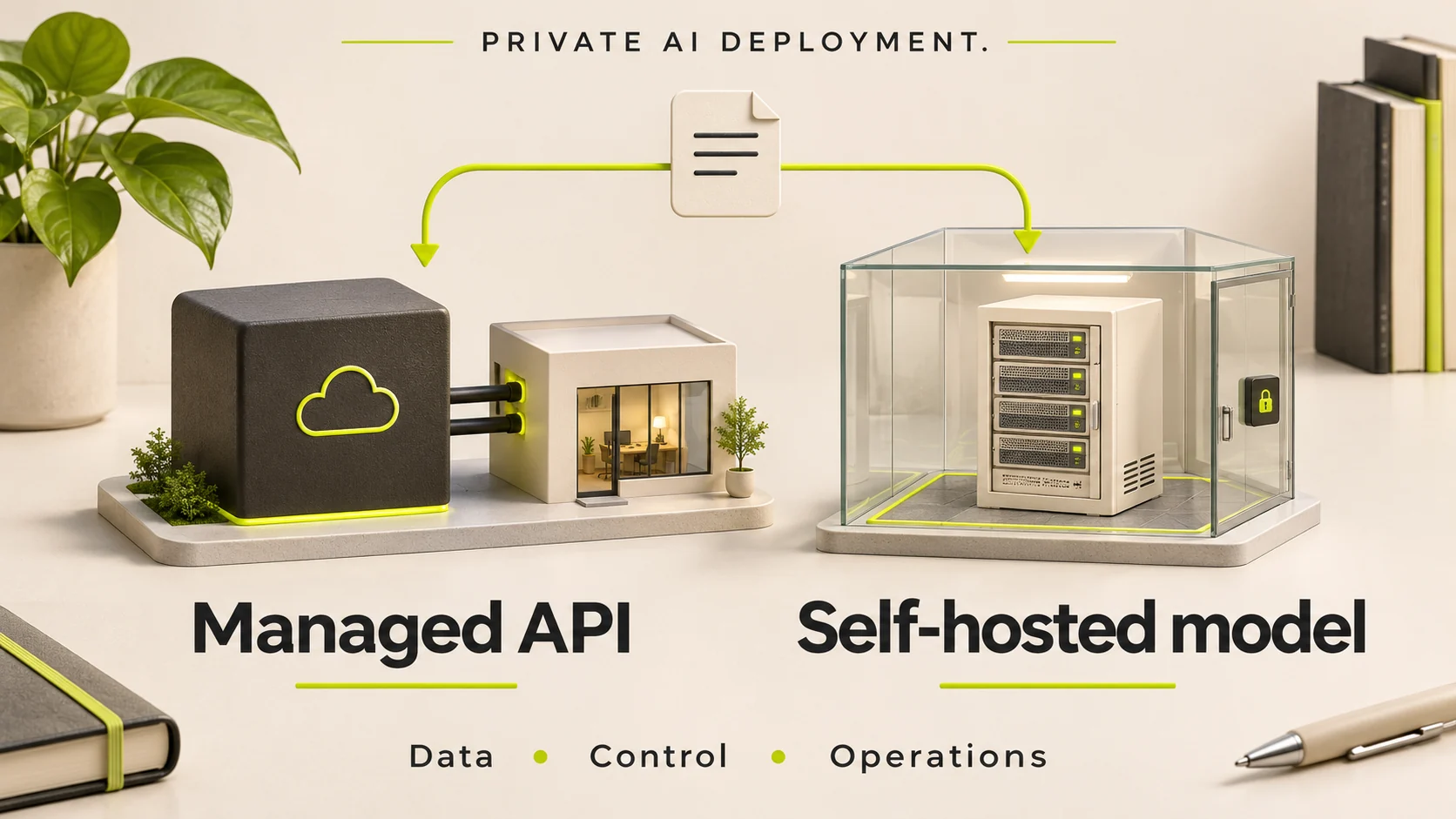
Choose a private AI deployment by the data it handles and the operations your team can sustain. A self-hosted model gives you more infrastructure responsibility. A managed API delegates part of that operation. Neither label, by itself, proves privacy, reliability or a lower total cost.
Before comparing models, draw the complete data path: user input, retrieval sources, model request, logs, caches, monitoring and human review. The most sensitive copy of a document may be in a debug log rather than in the model request.
Open weights expand the decision, not remove it
AWS's October 2026 Reflection Beam announcement describes an open-weight model and deployment options on AWS. It is one example of the expanding choices businesses face. Availability of model weights does not mean every model has the same licence, hardware needs or suitability for a business workflow.
This guide is a decision framework, not a recommendation to adopt that model. Evaluate the actual task and current terms before selecting any provider or deployment pattern.
Compare responsibilities explicitly
| Question | Managed API | Self-hosted model |
|---|---|---|
| Who operates inference? | Provider, within its service terms | Your team or chosen operator |
| Who controls application access? | Your application still must | Your application still must |
| Who plans capacity? | Quota and service-limit management | Hardware, scaling and availability management |
| Who maintains the model runtime? | Provider for its service | Your operator for the selected stack |
| What must be verified? | Terms, processing path, controls and behaviour | Licence, infrastructure, controls and behaviour |
Ask precise data questions
Which fields leave the application? Where can they be retained? Who can inspect logs? What is the deletion process? Does the proposed region apply to every connected component? Record verified answers from the actual configuration and applicable service terms; do not infer them from a product's privacy headline.
For self-hosting, include backups, observability tools, support access and outbound dependencies. Running a model on a private server does not prevent the application from sending retrieved content to another service. For an API, check the specific account and product configuration rather than assuming all consumer and enterprise offerings behave alike.
Use the same acceptance cases for both options
Prepare representative tasks with expected outputs and permission boundaries. Compare supported answer quality, tool behaviour, latency under realistic load and failure recovery. Keep the prompts and relevant context equivalent where possible, and document differences that cannot be removed.
A model that looks cheaper per request may require more retries or human corrections. A larger model may be unnecessary for simple classification. The decision should reflect accepted business work, not a leaderboard result from a different task.
Example: an internal policy assistant
Illustrative scenario: a small operations team wants answers from a restricted policy library. It compares a managed model API with a self-hosted alternative. Both candidates must respect document permissions and cite the current source. The self-hosted candidate also needs a named operator, capacity plan, patch process and a tested response when its server is unavailable.
If the team cannot support those responsibilities, self-hosting may introduce an operational gap even when the model answers well. If a verified data requirement rules out the proposed API path, convenience does not resolve that requirement. The company knowledge assistant guide explains the retrieval controls shared by either choice.
Plan an exit before committing
Keep source documents, evaluation cases and business rules under your control. Separate model-specific integration code from the core workflow where that is practical. Document which features would need replacement if you changed providers or model versions.
Do not promise perfect portability. Tool formats, context limits and model behaviour can differ. A useful exit plan identifies the work required and retains the evidence needed to assess a replacement.
Questions to settle with the operating team
Does open-weight mean open-source?
Not automatically. Read the actual licence and usage conditions. Access to weights and unrestricted rights to use, modify or redistribute are different questions.
Is a local model always cheaper?
No. Include infrastructure, idle capacity, maintenance, monitoring and review time, alongside inference costs. The answer depends on workload and operating capability.
Can we use different deployment patterns for different tasks?
Yes, if routing and data rules are explicit. Avoid sending restricted inputs to an alternative provider during a fallback unless that path is also authorised.
Choose an architecture your team can own
HINTX's DevOps and cloud infrastructure service and AI automation work address the system around the model. Bring the task, data constraints and operating resources so the deployment choice follows the business requirement.
Research checked 20 November 2026. Product availability can change. The cover is an AI-generated editorial illustration, not a client screenshot or performance result.



Login to comment
To post a comment, you must be logged in. Please login. Login
Comments (0)