
AI, Automation & Software
4 min read
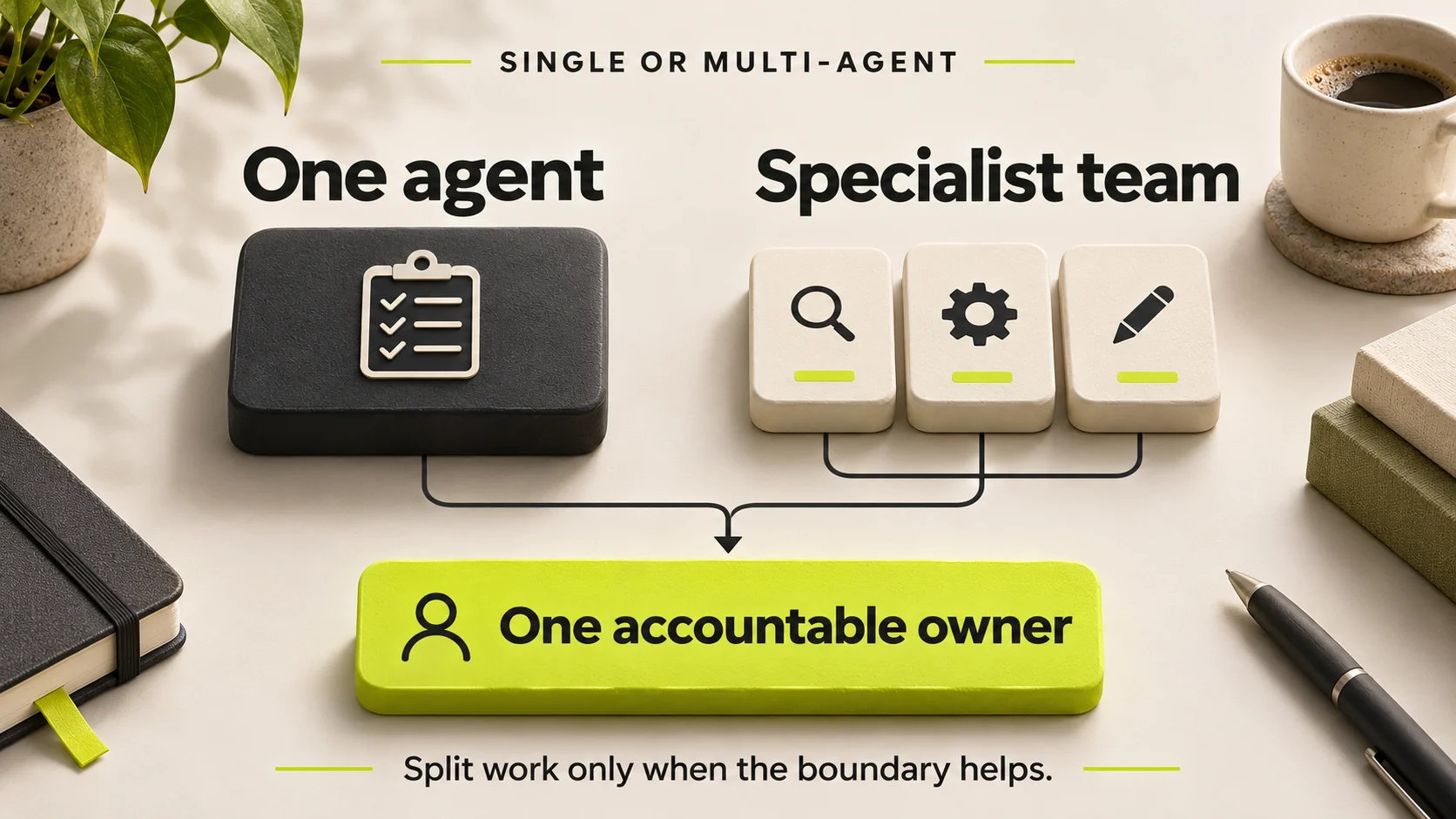
Use multiple AI agents when separating work creates a clear benefit that outweighs coordination cost. If one agent with a small tool set can complete the task reliably, adding a team of agents may only make failures harder to explain.
A useful split has an explicit input, output, authority boundary and owner. “Research agent,” “sales agent” and “manager agent” are labels, not a working operating model.
Why multi-agent operation needs closer attention
Microsoft's 17 November 2026 Azure Monitor announcement includes cross-agent debugging in public preview. The need to inspect work across agents is a reminder that orchestration creates additional operational questions.
Anthropic's earlier engineering account of its research system describes both the benefits of parallel research and the challenges of coordination and reliability. That is evidence from a particular research application, not proof that every business process needs several agents.
Three useful reasons to split work
Independent work: separate tasks can proceed without repeatedly editing the same state. For example, analysing two permitted document collections may be independent until results are compared.
Different authority: a read-only research component can be separated from a tightly controlled action component. The separation must be enforced by tools and identities, not just by different prompts.
Different expertise or context: a specialist may need a constrained document set or output contract. The coordinating component must still verify the result rather than accept any confident summary.
When one agent or a fixed workflow is better
Keep a straightforward sequence simple. If the steps are known, inputs are structured and decisions follow clear rules, an ordinary workflow may be easier to test. If the task needs flexible interpretation but little delegation, one bounded agent may be sufficient.
| Work pattern | Starting design | Reason |
|---|---|---|
| Known sequence with fixed rules | Deterministic workflow | Clear state and predictable checks |
| One task with a small tool set | Single bounded agent | Less coordination overhead |
| Independent evidence gathering | Specialist workers with a verifier | Separable inputs and results |
| Shared record with consequential writes | One authorised writer | Avoid conflicting actions |
Our agents versus traditional automation guide covers the earlier decision of whether an agent is needed at all.
Define handoffs as contracts
Each specialist should return a structured result: task identifier, evidence references, conclusion, unresolved questions and completion state. The coordinator should know whether the worker finished, failed or needs clarification. Silence and a polished partial summary should not both look like success.
Limit duplicate work. Set an owner for each source or task and define when a second opinion is useful. If every worker independently repeats the full investigation, costs can rise without adding meaningful coverage.
Example: preparing a supplier comparison
Illustrative scenario: one worker extracts delivery terms from authorised documents, another checks supported product specifications, and a coordinator prepares a comparison. The workers report their sources and missing information. The coordinator flags incompatible assumptions rather than averaging them into a confident recommendation.
Neither worker places an order. Procurement authority remains with the existing approved process. If ordering is added later, one controlled component should own the write and verify the final authorised values.
Keep shared state and retries under control
Choose one authoritative task record. Track which work is current, which result it supersedes and which operation has already completed. When a worker retries after a timeout, the system must recognise previous completion instead of creating a second action.
Set boundaries for time, tool calls and repeated delegation. Escalate when a task cannot be completed within those limits. A system that keeps asking more agents for help can conceal an unresolved input problem while consuming resources.
Compare the designs with the same cases
Run the single-agent and multi-agent candidates against the same representative tasks. Compare supported conclusions, permission behaviour, completion time, total processing and human review. Examine failures, not only successful demonstrations.
Keep the multi-agent design only where the separation adds measurable usefulness or a necessary authority boundary. Additional components should have a reason to exist and someone responsible for operating them.
Common questions
Do more agents make an answer more accurate?
Not automatically. Agents can repeat the same mistake or pass unsupported assumptions to one another. Independent evidence and verification matter more than headcount.
Is parallel browser automation the same thing?
No. Several browser sessions can run a fixed workflow without autonomous agent delegation. Our parallel browser workflow guide covers that separate architecture.
Who is accountable for the final action?
Name one business owner and one authorised execution path. Delegation should not make responsibility disappear.
Design the smallest useful system
HINTX automation implementation starts with the work and its boundaries. Share the process you want to split, the systems it touches and the decision that must remain accountable.
Research checked 20 November 2026. Product availability can change. The cover is an AI-generated editorial illustration, not a client screenshot or performance result.



Login to comment
To post a comment, you must be logged in. Please login. Login
Comments (0)