
AI, Automation & Software
5 min read
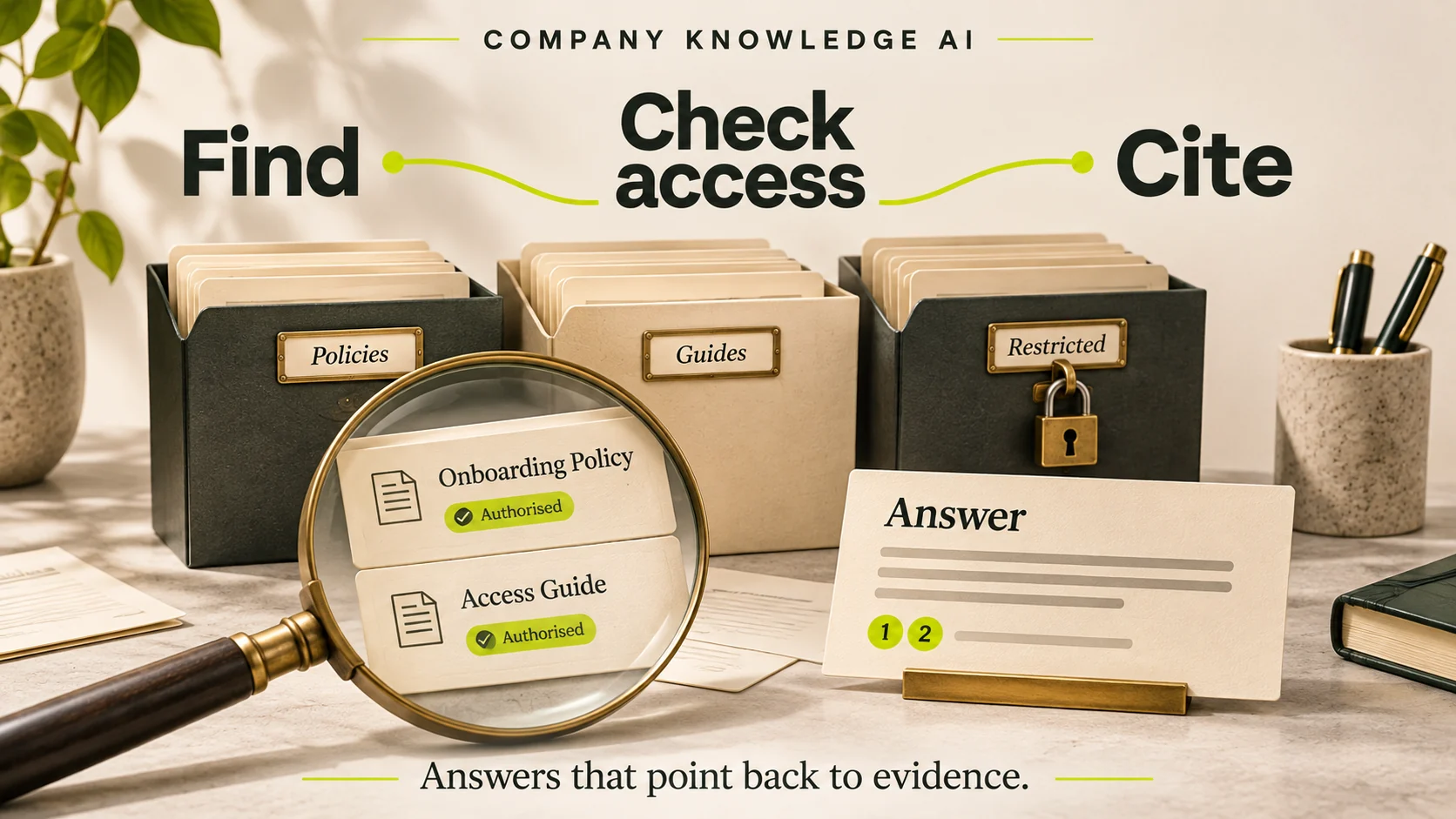
A useful company knowledge assistant must answer from information the employee is allowed to see, identify the source, and recognise when that source is incomplete or out of date. Uploading every company document into one searchable collection does not meet those requirements.
Retrieval-augmented generation, often called RAG, retrieves relevant material before an AI system writes an answer. That can make answers easier to check, but retrieval quality, document ownership and access rules still determine what the assistant can safely say.
What recent product updates tell buyers
Microsoft announced general availability of the indexed SharePoint knowledge source in Foundry IQ on 18 November 2026, describing permission-aware retrieval and source citations. This is a specific product capability, not a guarantee that every connector, region or document configuration behaves identically.
For a business evaluating an assistant, the significant question is whether access and provenance work in its actual document environment. The checklist below is an implementation proposal, not a claim that HINTX has deployed that Microsoft feature for a named client.
Choose a knowledge boundary people can maintain
Start with one owned collection, such as approved product manuals or internal operating procedures. Assign someone who can decide which document is authoritative, when it takes effect and what replaces it. Remove obsolete copies from retrieval without destroying records that must remain in the original archive.
Keep a source identifier, version, owner, effective date, retrieval timestamp and access classification. A file modified yesterday may contain an old policy, so the file timestamp alone is not a reliable effective date.
Check permissions before showing evidence
The system must respect access when retrieving documents and when displaying snippets, citations and cached answers. A hidden file should not become visible through a quoted passage or a descriptive document title. Shared answer caches need particular care when two employees have different permissions.
| Situation | Expected response | Test evidence |
|---|---|---|
| Employee has source access | Answer with an authorised citation | Accessible source and matching passage |
| Employee lacks source access | No restricted content or revealing snippet | Denied retrieval and safe answer |
| Two current documents conflict | Explain the conflict and escalate | Both versions identified for an authorised reviewer |
| Only expired guidance exists | State that current evidence is missing | Expiry rule and responsible owner |
A citation must support the answer
A link at the end of a paragraph is not enough. Check whether the cited passage actually supports the statement, whether exceptions were omitted, and whether the source applies to the product, location or date in the question. A source may describe standard delivery while the user asks about a restricted destination.
For important answers, expose the document name and relevant section so a person can inspect the evidence quickly. Do not require users to trust an unexplained confidence score. Confidence from a model or retrieval engine is not the same as a verified business decision.
Example: answering an internal delivery question
Illustrative scenario: a sales employee asks whether a particular product can be delivered on a requested date. The assistant finds a current delivery policy and a product manual, but neither contains live stock availability. It can explain the applicable policy and direct the employee to the authorised stock system. It should not turn a general delivery window into a promise for that order.
If live stock is later added, treat it as a separate source with its own timestamp and access rules. This keeps a knowledge answer distinct from a transactional commitment. The shopping-assistant readiness guide covers the customer-facing catalogue and checkout implications.
Evaluate the missing-answer cases
- A question with a clear current answer.
- A question using a synonym rather than the document's exact wording.
- A question requiring two permitted documents.
- A question whose answer exists only in a restricted document.
- A question with no supported answer.
- A question based on an obsolete document or conflicting versions.
Record the expected source and acceptable response for each case. Review retrieval and answer generation separately: the assistant may retrieve the right document but misstate it, or write cautiously because retrieval missed a relevant source. Those failures need different fixes.
Questions before commissioning a knowledge assistant
Should we train a model on all our files?
Not as a default. Retrieval may allow better source updates and access checks without embedding every document into model weights. The correct choice depends on the task and operating constraints.
Can citations eliminate incorrect answers?
No. They make checking easier when they are accurate. Unsupported conclusions and misleading excerpts still need evaluation and correction.
Who owns the assistant after launch?
Name both a technical operator and a knowledge owner. Someone must maintain connectors and access behaviour; someone must keep the underlying guidance authoritative.
Start with one dependable collection
HINTX combines software engineering with AI workflow implementation. Bring a sample question set and the document system you already use. That is a better starting point than a request to make all company knowledge searchable at once.
Research checked 20 November 2026. Product availability can change. The cover is an AI-generated editorial illustration, not a client screenshot or performance result.


Login to comment
To post a comment, you must be logged in. Please login. Login
Comments (0)