
AI, Automation & Software
4 min read
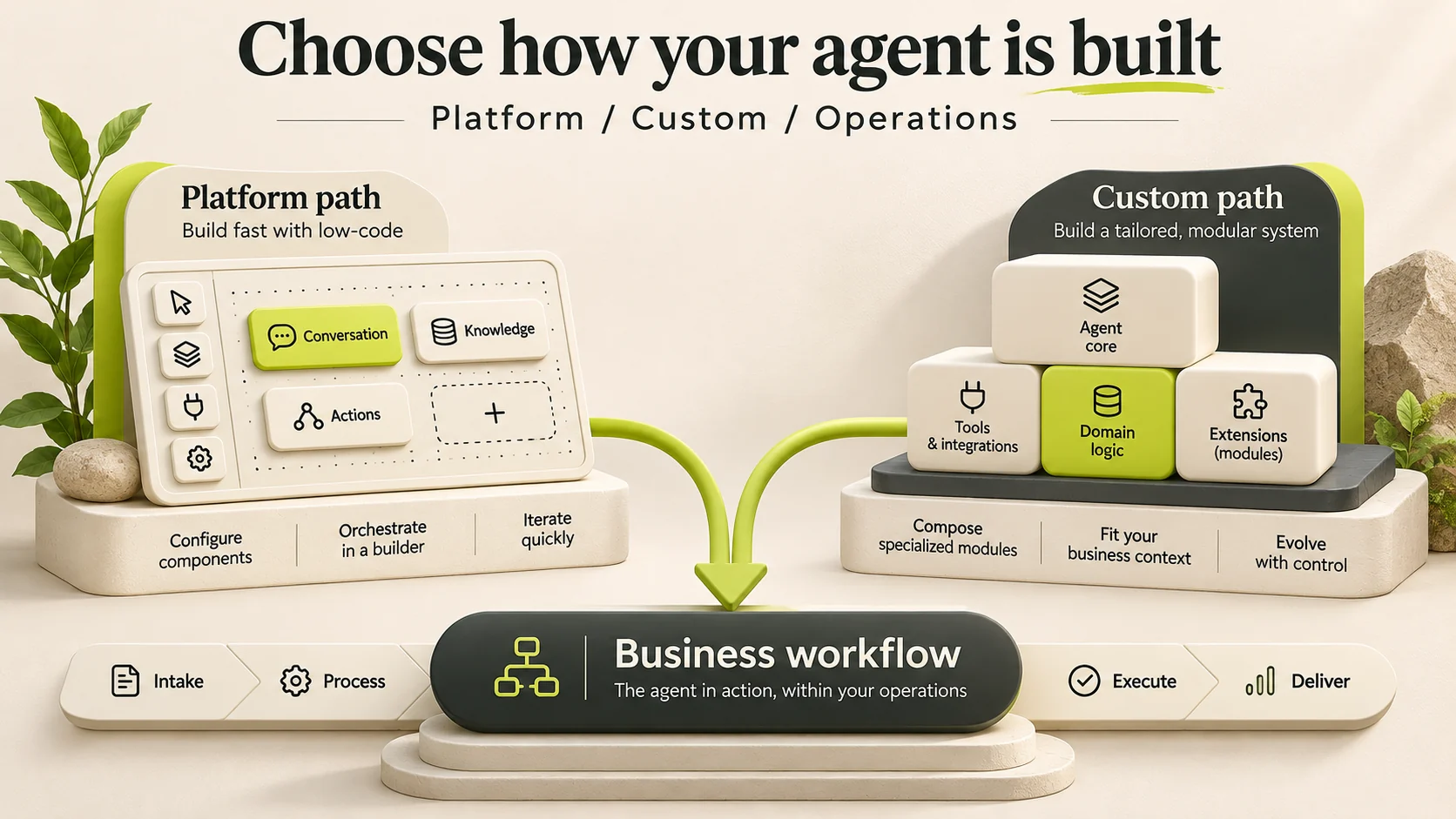
Copilot Studio and custom AI agents are implementation choices, not competing definitions of business value. Start by asking what the agent must do, which identity it uses and where its actions must be controlled. Then compare the options against that requirement.
Microsoft describes Copilot Studio as a graphical, low-code environment for building and managing agents and workflows connected to organisational systems. That makes it worth evaluating when your business already operates within Microsoft's environment. It does not establish that every required connector, permission or channel is available in your subscription.
Use one workflow to compare both approaches
Consider an employee asking for an order exception to be investigated. The agent needs to identify the employee, retrieve permitted order data, explain the issue and propose a next action. The same acceptance criteria should apply whether the implementation uses a platform or custom software.
- Can it enforce access to the correct records?
- Can it call the exact required API operations?
- Can approvals bind a specific proposed change?
- Can staff inspect failed and incomplete runs?
- Can the organisation maintain and export the necessary configuration?
When a platform deserves the first trial
A platform can be a sensible starting point when supported connectors and channels match the task, your team understands the administration model, and its governance controls fit your organisation. Evaluate licensing, environment management, data access and support together.
Ask the implementation team to demonstrate a permission failure and a connector outage, not only a successful chat. Confirm which responsibilities belong to Microsoft, which to your tenant administrators and which to the delivery partner. Low-code development still needs testing and operational ownership.
When custom development deserves consideration
A custom agent may be appropriate where you need unusual interfaces, complex business rules, bespoke integration behaviour or greater control over application deployment. Those benefits come with responsibility for security, monitoring, releases and ongoing compatibility.
Custom does not mean everything must be built from scratch. Existing libraries, model APIs and identity systems can be reused. Equally, a platform implementation may call a small custom service for a rule that needs strong transactional enforcement. Compare complete designs rather than labels.
Example: an approval-sensitive stock transfer
Illustrative scenario: a store manager asks an agent to move stock between branches. The assistant may gather availability and prepare a proposal. The inventory system must check permissions and current quantities when the transfer is approved. Neither platform convenience nor custom code justifies letting the model invent stock or bypass the authorising role.
Test what happens if stock changes during review. The system should reject or re-evaluate the stale proposal and explain the conflict. This test is more informative than asking which option produces the most fluent response.
Compare the operating commitment
Request a documented handover, current pricing assumptions and a clear exit path. Identify who responds when a connector changes or a model update affects output. Include review effort and support in the comparison, rather than treating the initial build as the whole cost.
Common questions
Does using Microsoft tools guarantee Copilot Studio is best?
No. Existing investment is relevant, but the specific workflow, permissions and commercial terms still need verification.
Can we combine platform and custom components?
Yes, where the integration is supported and the responsibility boundary is clear. Keep the design understandable to its future operators.
What should the first evaluation produce?
A small working demonstration, recorded limitations and a tested failure path, not a promise to automate the entire business.
Sources and further reading
Continue with custom software versus SaaS, AI agent acceptance testing.
Discuss your workflow
HINTX helps businesses connect practical operating needs with AI automation and software engineering. Explore our related service, or describe your current process and the problem you want to solve. A useful first discussion starts with your systems, constraints and intended outcome.
Research checked 24 November 2026. Examples are illustrative unless explicitly identified otherwise. Product capabilities and terms can change. The cover is an AI-generated editorial illustration, not a client screenshot or measured result.



Login to comment
To post a comment, you must be logged in. Please login. Login
Comments (0)