
AI, Automation & Software
4 min read
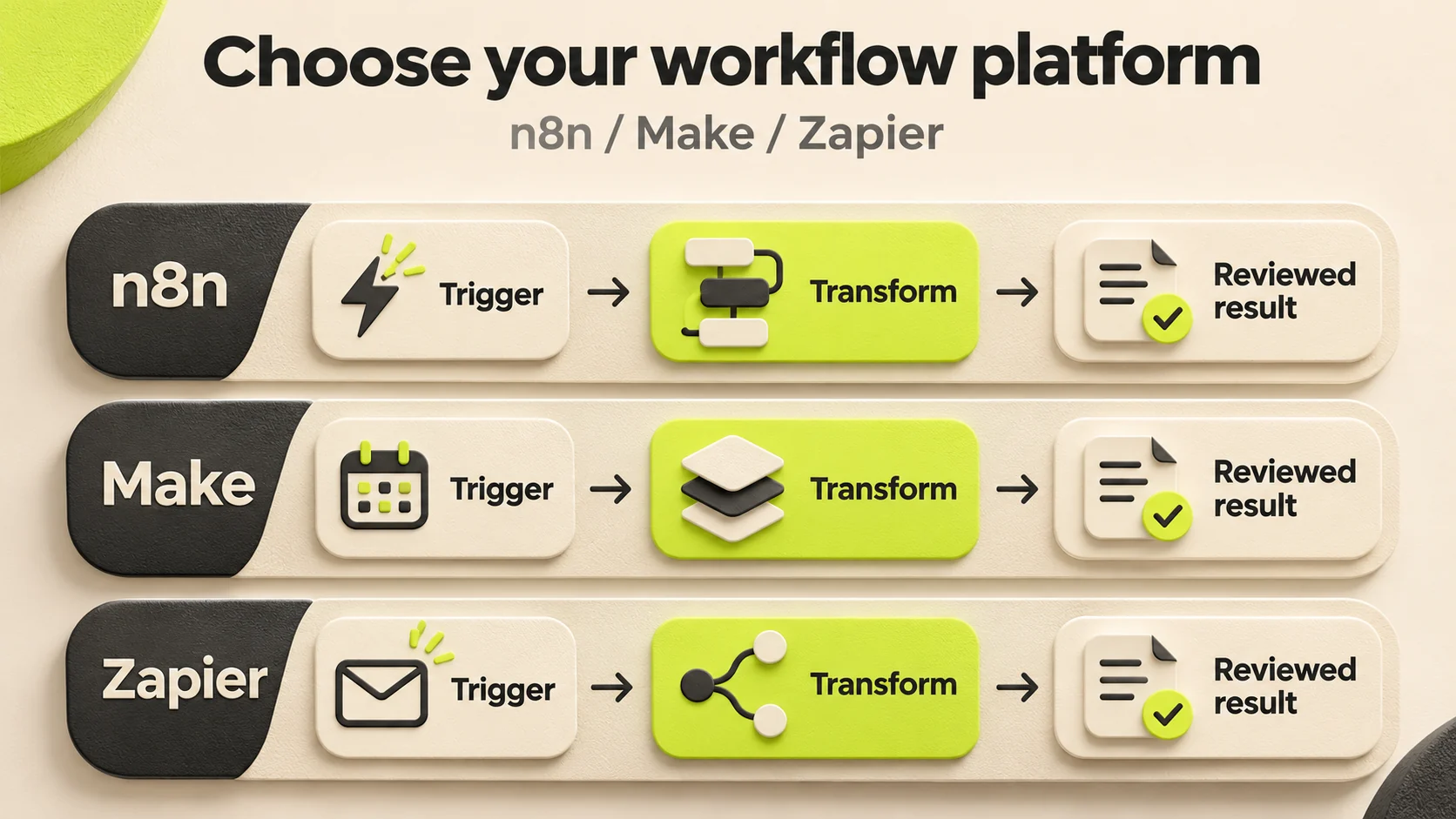
Choose an automation platform by testing the work you need it to perform. The relevant comparison is not which editor looks most powerful. It is whether your team can build, operate and recover the workflow at an acceptable total cost.
Use the same example in n8n, Make and Zapier: receive an enquiry, identify an existing CRM contact, create or update the correct record and notify its owner. Include missing information and a failed API request. A platform that handles the basic path still needs to pass those exceptions.
What each option brings to the decision
n8n documents self-hosting options as well as a hosted service. Self-hosting can give your team more infrastructure control, but it also gives that team responsibility for updates, access, backups and recovery. Check the edition and licence that apply to your intended use.
Make's documentation centres on scenarios, connected applications and error handling. Its visual approach can make branching data flows easier to discuss, provided the team understands how records move through the scenario.
Zapier offers an extensive application integration directory and trigger/action workflows. Verify the exact trigger, action and fields you need. An app appearing in the directory does not guarantee coverage of every endpoint or account plan.
Build a comparison around six checks
- Integration coverage: can it read and write the required objects with the right account permissions?
- Data handling: can it validate identifiers, dates, lists and optional fields?
- Failure recovery: can an operator inspect and retry failed work safely?
- Access: can staff share ownership without sharing personal credentials?
- Portability: what can be exported, documented and handed over?
- Cost: how does the actual workload map to the current plan's charging model?
Do not compare task, operation or execution allowances as though they were the same unit. Run a representative sample, record the billable activity and include retries. Check current provider pricing rather than relying on a screenshot from an older comparison article.
A practical proof of concept
Create a small anonymised test set containing a new contact, an existing contact, an incomplete enquiry and a duplicate submission. Specify the intended result before building. Where a model classifies the message, keep the original evidence available to the reviewer and represent unknown details explicitly.
Then disconnect a non-critical test integration or simulate its failure in an isolated environment. Confirm the workflow exposes a useful error and can resume without sending duplicate notifications. Never experiment by disrupting a live customer process.
The final handover should include a process map, connection owners, field mapping, failure instructions and the location of operational logs. A workflow that only its creator understands is not ready for unattended use.
When a custom component makes sense
You do not have to put every rule inside the automation editor. A small custom API can enforce a complex business invariant while the platform coordinates the surrounding steps. Keep consequential checks, such as whether an order already exists, in a system that can enforce them reliably.
Conversely, avoid building a custom service just to copy a supported field. Choose the smallest design that meets the acceptance criteria and that your team can maintain.
Common questions
Is self-hosting automatically cheaper?
No. Include infrastructure, engineering time, security maintenance and recovery work alongside subscription costs.
Can the platform replace every API integration?
No. Coverage depends on the specific application, permissions and operation. Unsupported actions may need a custom connector or service.
Should we migrate working workflows now?
Only for a demonstrated limitation or operating benefit. Migration itself introduces testing, training and maintenance costs.
Sources and further reading
Continue with planning n8n automation, business API integration strategy.
Discuss your workflow
HINTX helps businesses connect practical operating needs with AI automation and software engineering. Explore our related service, or describe your current process and the problem you want to solve. A useful first discussion starts with your systems, constraints and intended outcome.
Research checked 24 November 2026. Examples are illustrative unless explicitly identified otherwise. Product capabilities and terms can change. The cover is an AI-generated editorial illustration, not a client screenshot or measured result.


Login to comment
To post a comment, you must be logged in. Please login. Login
Comments (0)