
Business Strategy
4 min read
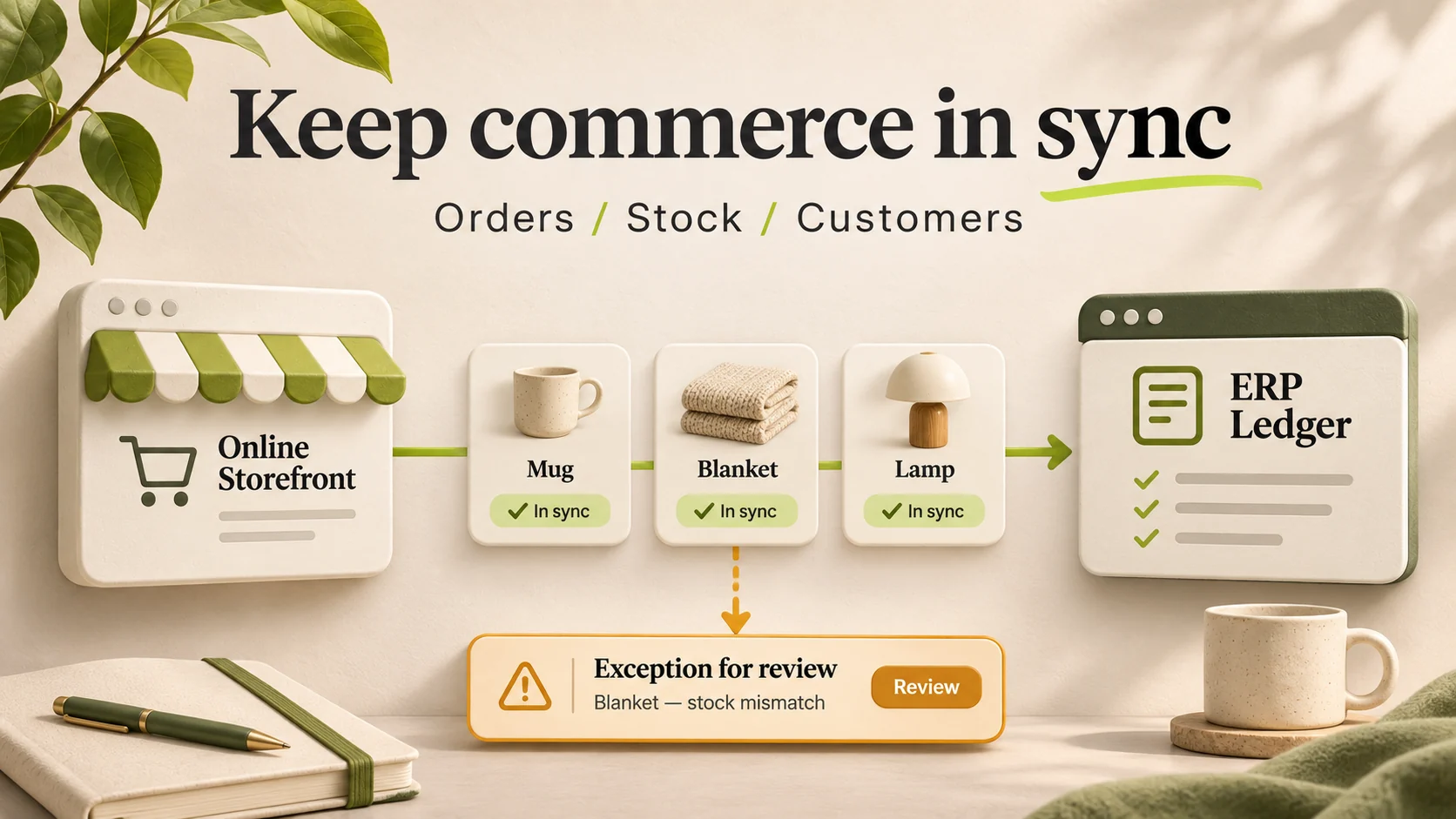
A Shopify ERP integration should make business records agree. An order must reach the fulfilment process once, stock must reflect the correct location, and staff must be able to explain discrepancies. Adding AI does not remove those requirements.
Begin by deciding which system owns each fact. Shopify may own the storefront order while the ERP owns warehouse availability and accounting classifications. The correct arrangement depends on your business; two systems editing the same field without a conflict rule is a common source of confusion.
Map objects before choosing a connector
List products, variants, locations, customers, orders, fulfilments and refunds. For each object, record the authoritative identifier, direction of transfer, update trigger and exception owner. A product title is not a stable substitute for a variant ID or agreed SKU mapping.
Distinguish available stock from physical stock, reserved stock and incoming stock. A synchronisation that copies the wrong quantity accurately can still oversell. Test multi-location allocation, cancellations and partial fulfilment before considering the integration complete.
Webhooks need reconciliation
Shopify documents that webhook ordering is not guaranteed and recommends reconciliation rather than relying entirely on event delivery. Design the integration to recognise repeated events, compare current record state and recover after an interruption.
Keep a durable mapping between the Shopify order and the ERP order. If a request times out, check whether the ERP already created the order before trying again. Record an unknown outcome explicitly; guessing that a timeout means failure can create duplicate fulfilment work.
Example: a partially fulfilled order
Illustrative scenario: an order contains items from two warehouses. The first warehouse ships its item while the second reports a stock shortage. The integration should preserve separate fulfilment states, expose the shortage and communicate only the confirmed shipment. It should not mark the whole order delivered or reduce stock twice when a delayed event arrives.
Build a reconciliation view around mismatches staff can act on: orders missing in one system, inventory disagreements, failed customer matches and refunds without a linked transaction. Assign each exception to a team and retain the original event reference.
Where AI can help
AI may summarise an exception, classify an unstructured supplier message or draft a customer explanation from verified records. Deterministic code should continue to enforce identifiers, quantities, authorised state transitions and financial rules. A model should not repair a stock discrepancy by inventing a quantity.
Let an operator inspect the proposed change before applying it. If the underlying order changes while the proposal is being reviewed, require a fresh check. Keep explanations separate from executable instructions.
Define an acceptance pack
- New order and repeated event produce one ERP order.
- Partial shipment remains partial in both systems.
- Cancellation follows the agreed reservation rule.
- Refund links to the original financial record.
- Expired credentials produce an alert without losing work.
- Reconciliation identifies a deliberately omitted test event.
Agree how the integration will be monitored and who owns changes when either platform updates its API. Connector availability alone does not establish compatibility with your ERP customisations or Shopify account permissions.
Common questions
Do we need real-time sync for every field?
No. Choose timing by business consequence. Availability may need tighter freshness than a descriptive field used in an internal report.
Can a standard connector handle our workflow?
Possibly. Validate the exact objects, custom fields and exceptions before choosing custom development.
Should AI control inventory?
Use authoritative inventory records and explicit rules. AI can assist investigation but should not become an undocumented source of stock truth.
Sources and further reading
Continue with API integration strategy, B2B ordering workflows.
Discuss your workflow
HINTX helps businesses connect practical operating needs with AI automation and software engineering. Explore our related service, or describe your current process and the problem you want to solve. A useful first discussion starts with your systems, constraints and intended outcome.
Research checked 24 November 2026. Examples are illustrative unless explicitly identified otherwise. Product capabilities and terms can change. The cover is an AI-generated editorial illustration, not a client screenshot or measured result.



Login to comment
To post a comment, you must be logged in. Please login. Login
Comments (0)