
AI, Automation & Software
4 min read
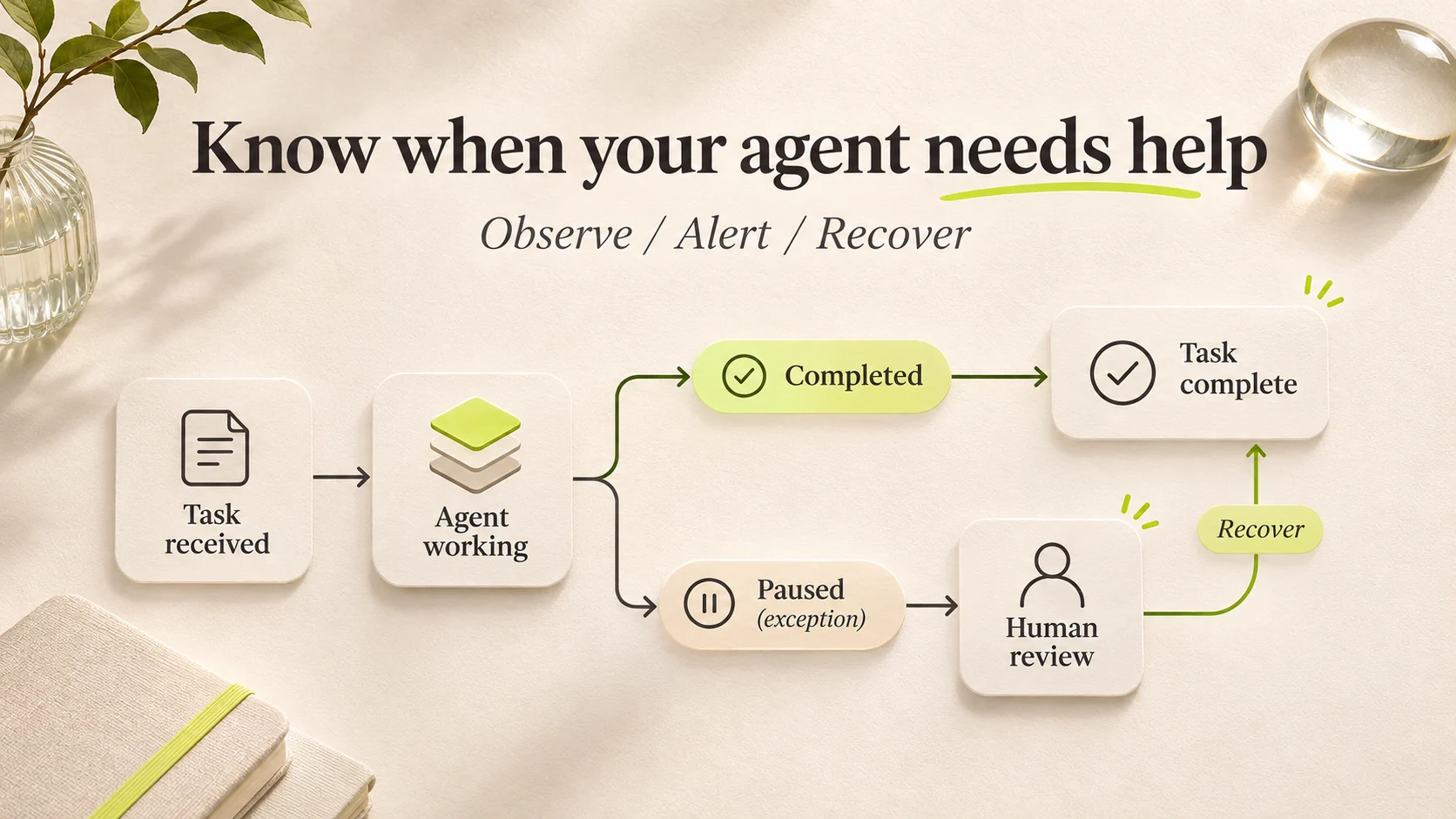
AI agent monitoring should tell an operator whether useful work completed, what failed and what needs a decision. Token usage and response time matter, but neither proves that an order was updated correctly or a customer received an accurate answer.
Define the task lifecycle before choosing dashboards. A run may be received, working, waiting for approval, completed, rejected or unresolved. Keep those states tied to evidence from the connected systems rather than to the model's own statement that it finished.
Observe the complete operation
Record a task identifier across the application, model request and tool calls. OpenTelemetry's generative AI conventions provide a developing vocabulary for instrumentation. Check the current convention and library versions when implementing; the choice of telemetry tooling does not define your business success criteria.
Useful records include the requested operation, permitted actor, target reference, approval state, tool result and final business outcome. Avoid recording entire prompts or customer documents by default. An operator often needs a secure reference to the source, not another copy of sensitive content.
Distinguish technical and business failures
- Provider failure: the model or API did not return a usable response.
- Permission failure: the requested action was correctly denied.
- Validation failure: required facts or current-state checks did not pass.
- Business failure: the intended outcome was not achieved.
- Unknown outcome: the system cannot yet establish what happened.
A denied unauthorised refund is not a reliability defect to remove. An agent that reports success after a failed database update is. Your monitoring should preserve that distinction.
Example: a timeout after a successful action
Illustrative scenario: an agent creates a service ticket, but the connection drops before the response arrives. Retrying blindly could create a duplicate. The operator view should expose the operation identifier and support checking the original result before repeating the action.
Keep unresolved tasks visible until reconciled. Do not mark them completed simply because the worker process stopped. If manual intervention is required, provide the evidence and permitted recovery actions in one place.
Make alerts actionable
Assign an owner and response path to each alert. Group repeated symptoms from the same outage, and distinguish an isolated retryable error from a growing backlog. An alert should explain the affected workflow, time range and next check.
Define when the system pauses automation and falls back to manual work. Test that control in a safe environment. A monitoring dashboard that nobody watches and no alert reaches does not provide operational protection.
Review quality changes over time
Sample completed work and compare it with acceptance criteria. Track reviewer corrections, escalations and reopened tasks alongside latency and cost. Record model, prompt, tool and knowledge changes so a regression can be investigated.
Use a known evaluation set before releases, then monitor real operating evidence afterwards. A passing pre-launch test does not guarantee every future input will be handled correctly. Keep a path to disable the affected capability without taking down unrelated business functions.
Common questions
Do we need a large observability platform?
Not necessarily. Start with useful task records, alerts and a clear operator. Add infrastructure when scale or investigation needs justify it.
Should we log every conversation?
Only where justified by the operating need and data-handling policy. Prefer minimal records and controlled source access.
Is model confidence a success metric?
No. Verify outcomes in the business system and review representative results.
Sources and further reading
Continue with AI agent acceptance testing, AI cost per task.
Discuss your workflow
HINTX helps businesses connect practical operating needs with AI automation and software engineering. Explore our related service, or describe your current process and the problem you want to solve. A useful first discussion starts with your systems, constraints and intended outcome.
Research checked 24 November 2026. Examples are illustrative unless explicitly identified otherwise. Product capabilities and terms can change. The cover is an AI-generated editorial illustration, not a client screenshot or measured result.



Login to comment
To post a comment, you must be logged in. Please login. Login
Comments (0)