
AI, Automation & Software
4 min read
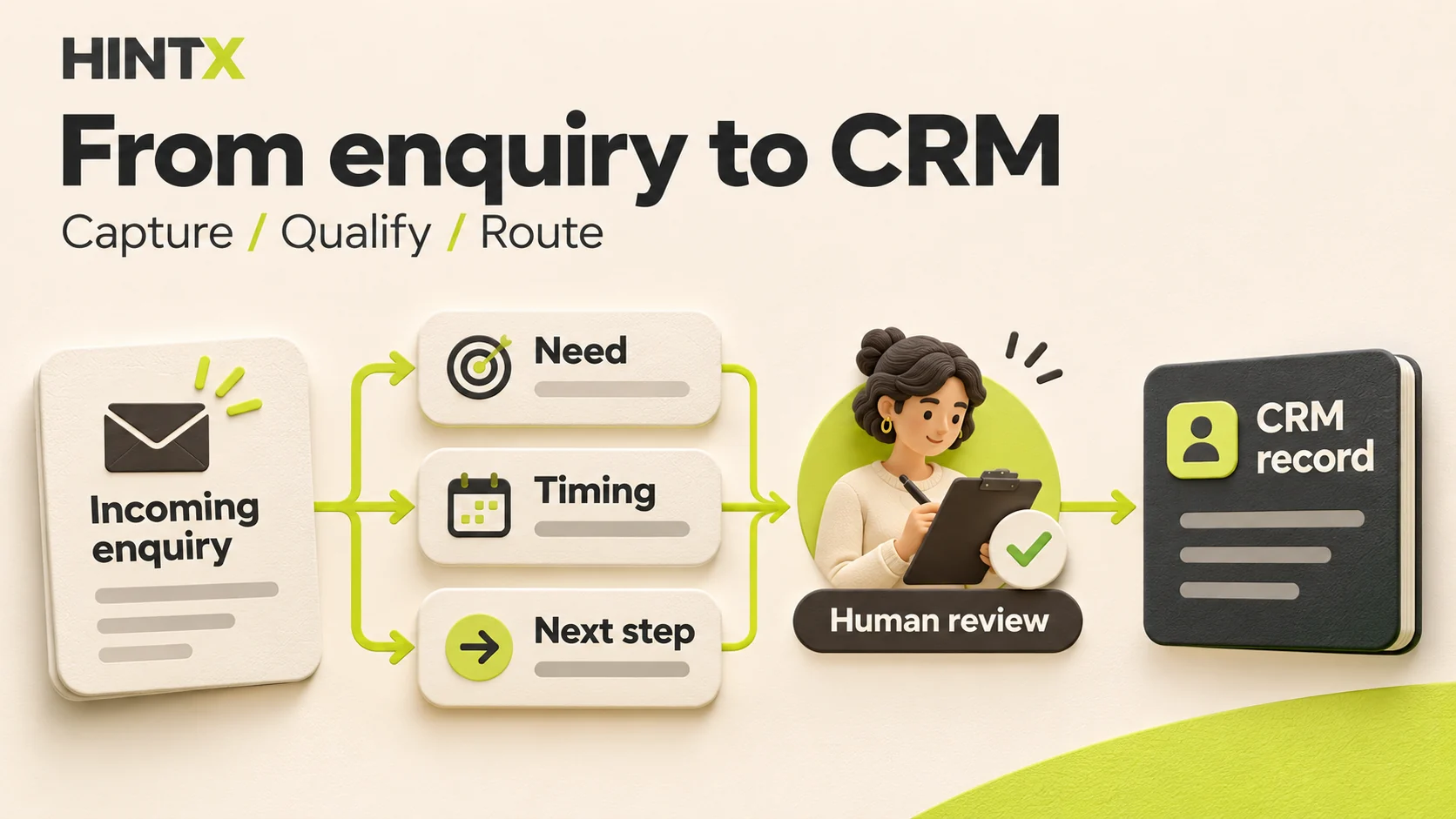
AI lead qualification is useful when it helps a salesperson understand an enquiry and decide what to do next. It becomes unreliable when it invents budget, urgency or purchase authority from a short message. A structured CRM record should distinguish what the buyer said from what the system inferred.
Start with inbound enquiries your business is entitled to handle. This workflow is not a justification for scraping contact lists or sending unsolicited campaigns. Its purpose is to reduce the administrative work between a legitimate request and a useful conversation.
Define qualification before assigning scores
Write a short definition of a relevant opportunity: a described business need, a service your team can deliver, and an agreed next conversation. A form submission is not automatically a qualified lead. A large company name does not establish a budget or authority.
Useful fields include the stated problem, systems involved, requested timing, location if relevant, source of the enquiry and unanswered questions. Keep unknown values empty. Store evidence excerpts or references so a reviewer can check why a field was populated.
Connect the conversation to the correct record
HubSpot's contact API documentation illustrates the distinction between contact properties and relationships to other CRM objects. Whichever CRM you use, decide whether an enquiry creates a new contact, updates a known contact or starts a separate opportunity. Do not overwrite verified customer details with guesses extracted from a message.
- Validate the submitted fields and assign an enquiry identifier.
- Look for an existing record using approved matching rules.
- Extract the stated business need and missing information.
- Apply explicit routing rules for service and territory.
- Send ambiguous matches or important changes to a reviewer.
- Record the next action and responsible person.
Example: interest without a defined project
Illustrative scenario: a retailer asks whether AI could help its customer service team. The message names a helpdesk but gives no budget or launch date. The useful output is “customer service assessment requested”, the named system, and questions about current ticket types and access. It is not “high-budget project, ready to buy”.
A second message from the same person should update the enquiry history rather than create a competing contact. If two companies share an email domain or a consultant represents several clients, route the ambiguity to a person instead of automatically merging accounts.
Keep routing accountable
Let sales staff see and correct the extracted fields. Record those corrections so repeated mistakes can be investigated. Avoid silently changing pipeline stages based solely on model confidence. Stage definitions should correspond to observable business events.
When the CRM is unavailable, retain the enquiry safely and surface a delivery failure. A successful classification is not proof the record reached the CRM. Retrying should use the original enquiry identifier so the recovery does not create duplicates.
Measure useful follow-up
Track time to first meaningful response, routing corrections, duplicate contacts, unanswered enquiries and the share of requests that reach an agreed next step. Review outcomes by enquiry type. Do not claim increased sales from a higher automated score or a larger count of created records.
Common questions
Can AI decide which leads to reject?
It can flag clear mismatches against documented criteria. Keep a review path for incomplete or ambiguous requests, particularly when a genuine buyer may have explained the need poorly.
Do we need a numerical lead score?
Not necessarily. Clear fields, evidence and an assigned next action can be more useful than an unexplained number.
Should the assistant send a proposal immediately?
Only within an explicitly approved workflow. Qualification should not invent commercial scope or commit your business to terms.
Sources and further reading
Continue with internal business management platforms, commercial search intent.
Discuss your workflow
HINTX helps businesses connect practical operating needs with AI automation and software engineering. Explore our related service, or describe your current process and the problem you want to solve. A useful first discussion starts with your systems, constraints and intended outcome.
Research checked 24 November 2026. Examples are illustrative unless explicitly identified otherwise. Product capabilities and terms can change. The cover is an AI-generated editorial illustration, not a client screenshot or measured result.


Login to comment
To post a comment, you must be logged in. Please login. Login
Comments (0)