
AI, Automation & Software
4 min read
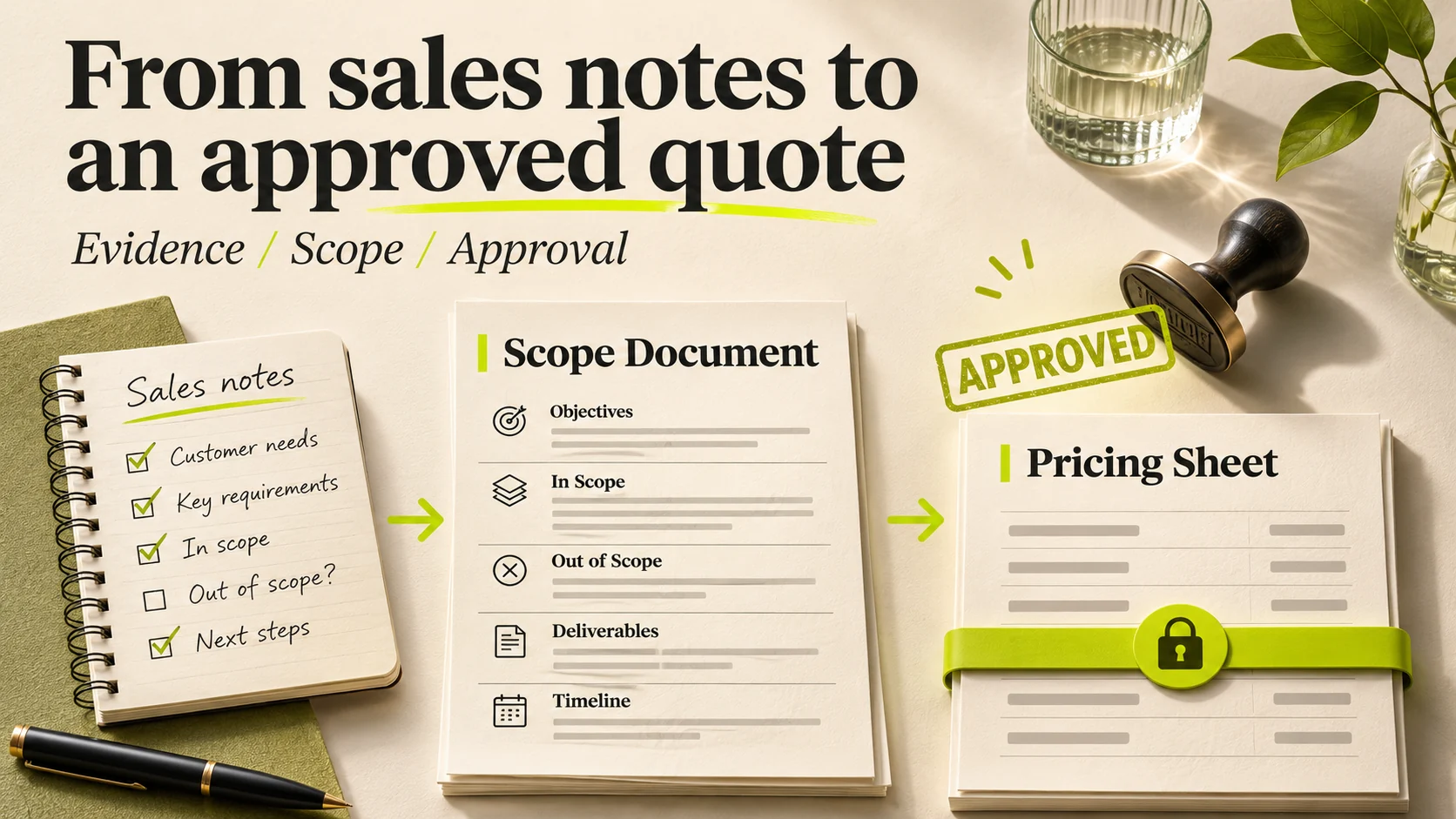
AI sales proposal automation should help a team prepare accurate drafts faster. It should not create obligations the team has not agreed to deliver. The safest starting point is a draft assembled from verified CRM information, approved service descriptions and current commercial rules.
Separate narrative drafting from pricing and approval. A model can summarise the customer's problem and organise a proposed approach. Prices, discounts, terms and delivery commitments need an authoritative source and an authorised reviewer.
Build an evidence pack for each proposal
Collect the confirmed business need, systems involved, agreed objectives, exclusions, assumptions and unanswered questions. Preserve the distinction between a customer's request and something your team has accepted. A meeting note saying “could launch next month” is not an approved delivery date.
CRM deal APIs, such as HubSpot's, expose structured deal properties and associations. Map those records deliberately. The presence of a deal in a particular stage does not establish that every attached note is accurate or approved for external use.
Use controlled sections
- Customer context: supported by discovery notes.
- Proposed scope: reviewed by the delivery owner.
- Assumptions: explicit dependencies and access requirements.
- Commercial terms: drawn from approved sources.
- Acceptance: observable completion criteria.
- Next step: the action the recipient is being asked to take.
Mark unresolved details inside the internal draft. Do not replace blanks with plausible estimates merely to make the document look finished. A proposal with a visible question is easier to correct than one containing an invented promise.
Example: a requested integration with unknown access
Illustrative scenario: a prospect wants its booking system connected to accounting software, but API access has not been confirmed. The draft can describe a discovery step and the intended information flow. It should not promise a specific connector, fixed implementation date or unsupported level of automation.
The delivery reviewer should see that dependency before commercial approval. If the scope changes after approval, generate a new version and require another review. Approval belongs to the exact document and terms that will be sent.
Keep sending separate from drafting
A document marked “ready for review” should not be emailed automatically. Use an explicit send action tied to the approved version and correct recipient. Store the sent version, timestamp and delivery result without assuming provider acceptance means the recipient read it.
Protect confidential notes and other clients' information. Limit retrieval to the relevant opportunity and approved reference material. Test prompts that attempt to include unrelated customer records or change prices outside the permitted workflow.
Measure drafting quality
Track reviewer edits, missing dependencies, inaccurate scope statements and time to an approved proposal. Faster generation is not a benefit if reviewers must repair the whole document. Compare like-for-like proposal types and keep sales outcomes distinct from drafting metrics.
Common questions
Can AI choose a discount?
It can present options from approved rules, but discount authority should remain enforced by the commercial workflow.
Can previous proposals be reused?
Yes, after removing confidential material and checking that scope and terms remain applicable. Similar wording does not mean the projects are equivalent.
Do we need a new proposal platform?
Not necessarily. Start with the existing CRM and document process, then add only the missing integration and review controls.
Sources and further reading
Continue with internal business platforms, AI tool permissions.
Discuss your workflow
HINTX helps businesses connect practical operating needs with AI automation and software engineering. Explore our related service, or describe your current process and the problem you want to solve. A useful first discussion starts with your systems, constraints and intended outcome.
Research checked 24 November 2026. Examples are illustrative unless explicitly identified otherwise. Product capabilities and terms can change. The cover is an AI-generated editorial illustration, not a client screenshot or measured result.



Login to comment
To post a comment, you must be logged in. Please login. Login
Comments (0)