
Digital Growth & Search
5 min read
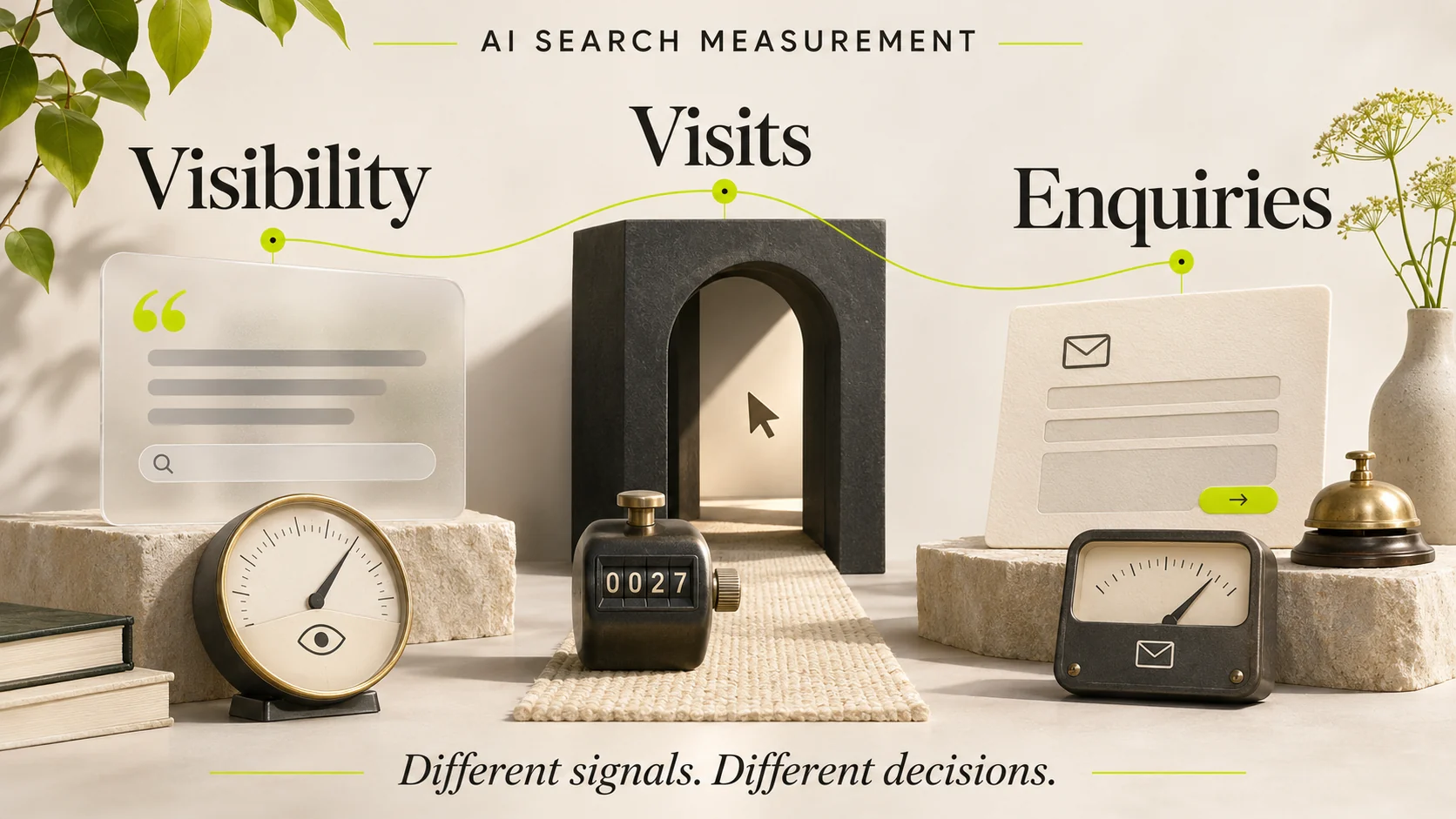
An AI answer can mention your business without sending a visitor. A visitor can read your guide without making an enquiry. Measure those stages separately before deciding whether your content is helping the business.
Start with three evidence sets: visibility reported by a search provider, activity on your own website, and enquiries that your team has qualified. Keep each source's dates, definitions and limitations. Joining them into one impressive number usually makes the report less useful.
What changed in AI search reporting?
Bing introduced Topics Portfolio in beta on 13 October 2026. Where sufficient site data exists, it groups a site's AI search presence into topics and surfaces opportunity queries. Its estimates are specific to that reporting environment, not a universal keyword-volume database.
Google's Search Generative AI performance reports were announced in June, with the announcement updated on 31 August to record worldwide rollout. That makes older blanket statements that Search Console cannot separate this activity unreliable. Check the actual report available in your property and its definitions before preparing a comparison.
These developments make measurement more practical. They do not prove that a citation caused a sale, or that a particular optimisation caused the citation.
Build a report around decisions
| Evidence | Useful question | Do not infer |
|---|---|---|
| Provider citations or impressions | Which relevant questions expose our content? | Unique people, visits or revenue |
| Website visits and engagement | Which pages receive observable traffic? | Complete traffic attribution across every AI app |
| Qualified enquiries | Did a relevant buyer describe a business need? | That every form submission is a sales opportunity |
| Accepted opportunities | What next step did the buyer agree to? | Won revenue before an actual agreement |
Choose an owner for each question. Marketing can classify the subject of a citation. Analytics can describe observed page activity. The person handling enquiries must decide whether the request fits your services. A dashboard should preserve those distinctions.
A weekly measurement sheet you can actually use
For every observation, record the provider, report name, exact period, country or device filters, query or topic, cited URL, metric definition and export date. Add a separate field for the page's intended buyer question. This makes a broad topic such as automation distinguishable from an enquiry about connecting an order system to a warehouse.
Keep missing values blank or explicitly unavailable. A report with no data is not evidence of zero visibility. Do not add impressions from two platforms and call the total unique reach. Where a generative report is already included in a wider search report, adding the two can double-count the same activity.
Compare equal, complete periods. Keep a note when a page changes, but avoid calling a subsequent rise an experiment result unless other plausible explanations have been considered. Search demand, provider coverage and competitor activity can all change.
Example: a useful citation with no immediate lead
Illustrative scenario: a software agency finds that its guide to invoice exceptions is cited for a relevant operations question. Its analytics shows a small number of observable visits to that guide, while the enquiry team reports no attributable request. The correct finding is visibility with limited observed business response. It is not a failed sale, and it is not proof of a successful acquisition channel.
The next review should examine the page itself. Does it explain who the service fits? Does it show a practical decision, an honest limitation and an obvious route to discuss the reader's workflow? Those checks are more useful than inserting the phrase AI optimisation into every heading.
Turn observations into one bounded action
- Identify a relevant question already supported by evidence.
- Choose the existing page that owns that question.
- Check whether the page answers it directly and supports its claims.
- Improve one clear gap, preserving useful content and the stable URL.
- Record the change date and review a later comparable period.
Do not generate a new page for every variation in an AI answer. Our commercial search intent guide explains how to connect a buyer's question to the right page. For terminology, use the existing SEO, AEO and GEO guide.
Questions businesses ask
Does a citation mean an AI system recommends us?
Not necessarily. Read the surrounding answer and the reporting definition. A source can support a factual statement without being a supplier recommendation.
Can we promise a ranking in AI answers?
No. Providers select and present sources differently. Useful content and technical accessibility can support eligibility; neither guarantees a position, citation or lead.
Should we change tracking just to fill the report?
Only after reviewing the actual need and privacy controls. Consent gaps and unavailable attribution should be documented, not hidden through more invasive collection.
Make the next content decision evidence-led
HINTX's digital growth and marketing intelligence service connects content decisions with business questions. Bring your current reports and one priority service; the first useful outcome is a clear measurement baseline and a short list of justified improvements.
Research checked 20 November 2026. Product availability can change. The cover is an AI-generated editorial illustration, not a client screenshot or performance result.


Login to comment
To post a comment, you must be logged in. Please login. Login
Comments (0)