
Business Strategy
4 min read
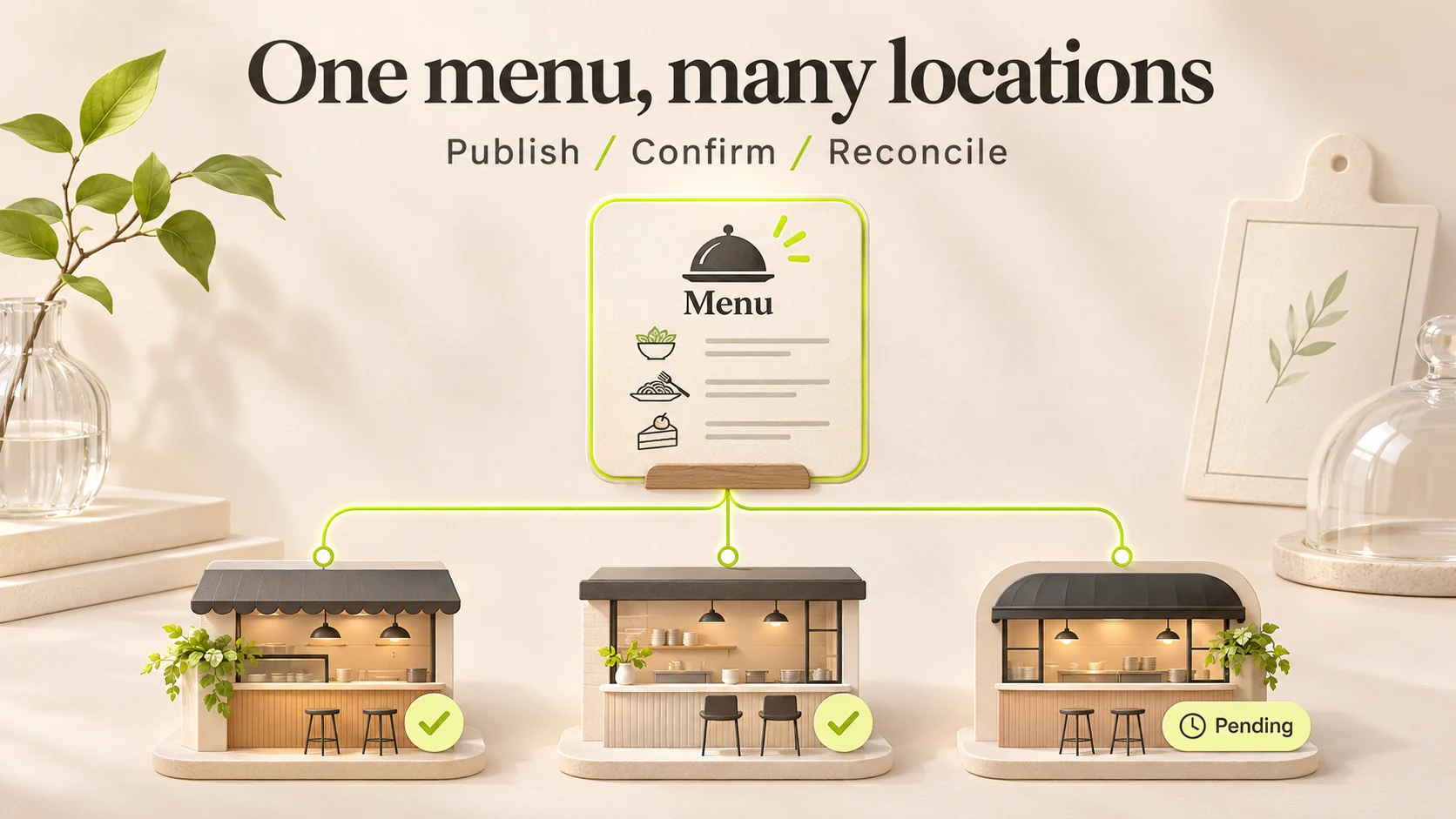
Multi-location restaurant automation is not just publishing one menu everywhere. It must preserve the differences that matter: local availability, opening hours, modifiers, equipment constraints and approved pricing. The difficult question is how to coordinate changes without hiding those exceptions.
Choose a catalogue owner and document which fields branches can override. A central item description may be shared while availability remains location-specific. Treat those as separate facts rather than letting the last update overwrite everything.
Create a stable menu model
Use persistent identifiers for items, variants, modifiers and locations. Map each external ordering channel to those identifiers. Similar names are not sufficient: two menu items can share a label but have different portions, preparation requirements or modifier rules.
Square's Catalog API illustrates how catalogue objects reference one another. Your own integration should respect those dependencies when a modifier or variation changes. Removing a modifier without checking its parent items can leave an ordering interface inconsistent.
Publish a version, then confirm it
- Prepare the proposed menu changes.
- Validate required fields and supported channel mappings.
- Obtain the relevant operational approval.
- Publish to the selected locations and channels.
- Record acknowledgement from each destination.
- Reconcile pending or failed destinations.
A successful central save does not prove every kiosk or delivery channel received the update. Show per-location status and the last confirmed version. Avoid a single green “published” badge when one branch is still using older information.
Example: a temporary ingredient shortage
Illustrative scenario: one branch runs out of an ingredient used by several items. The local availability change should affect the relevant items and channels at that branch, while preserving the central descriptions and other branches' availability. When stock returns, the reversal should restore only the intended availability settings.
Allergen and ingredient information needs a verified operational source. Do not let AI infer an allergen statement from a recipe name or substitute an ingredient without the business's established review process.
Where AI is useful
AI can summarise a change request, flag inconsistent descriptions or group recurring availability exceptions for investigation. It should not decide that a kitchen can fulfil an item without authoritative confirmation. Keep availability rules and order acceptance connected to the operational system.
For offline or disconnected devices, define what customers can order and how staff see the limitation. A stale menu should not silently accept unavailable items merely because the screen still displays them.
Test a real rollout sequence
Use a test location or controlled environment to check modifier changes, scheduled availability, failed publication, device reconnection and rollback to a known menu version. Confirm that an older delayed update cannot replace a newer approved version.
Measure rejected orders, availability corrections, publication delays and staff effort resolving mismatches. Do not claim a branch-count capability or sales improvement without evidence from an actual deployment.
Common questions
Should every location have an identical menu?
Only where that matches operations. A shared model can support explicit local differences without separate unmanaged copies.
Can AI write ingredient descriptions?
It can help present verified information, but ingredient and allergen facts require authoritative review.
Is a new POS necessary?
First assess the existing POS and channel APIs. The missing piece may be coordination and reconciliation rather than replacement.
Sources and further reading
Continue with restaurant POS architecture, self-service kiosk design.
Discuss your workflow
HINTX helps businesses connect practical operating needs with AI automation and software engineering. Explore our related service, or describe your current process and the problem you want to solve. A useful first discussion starts with your systems, constraints and intended outcome.
Research checked 24 November 2026. Examples are illustrative unless explicitly identified otherwise. Product capabilities and terms can change. The cover is an AI-generated editorial illustration, not a client screenshot or measured result.



Login to comment
To post a comment, you must be logged in. Please login. Login
Comments (0)