
AI, Automation & Software
6 min read
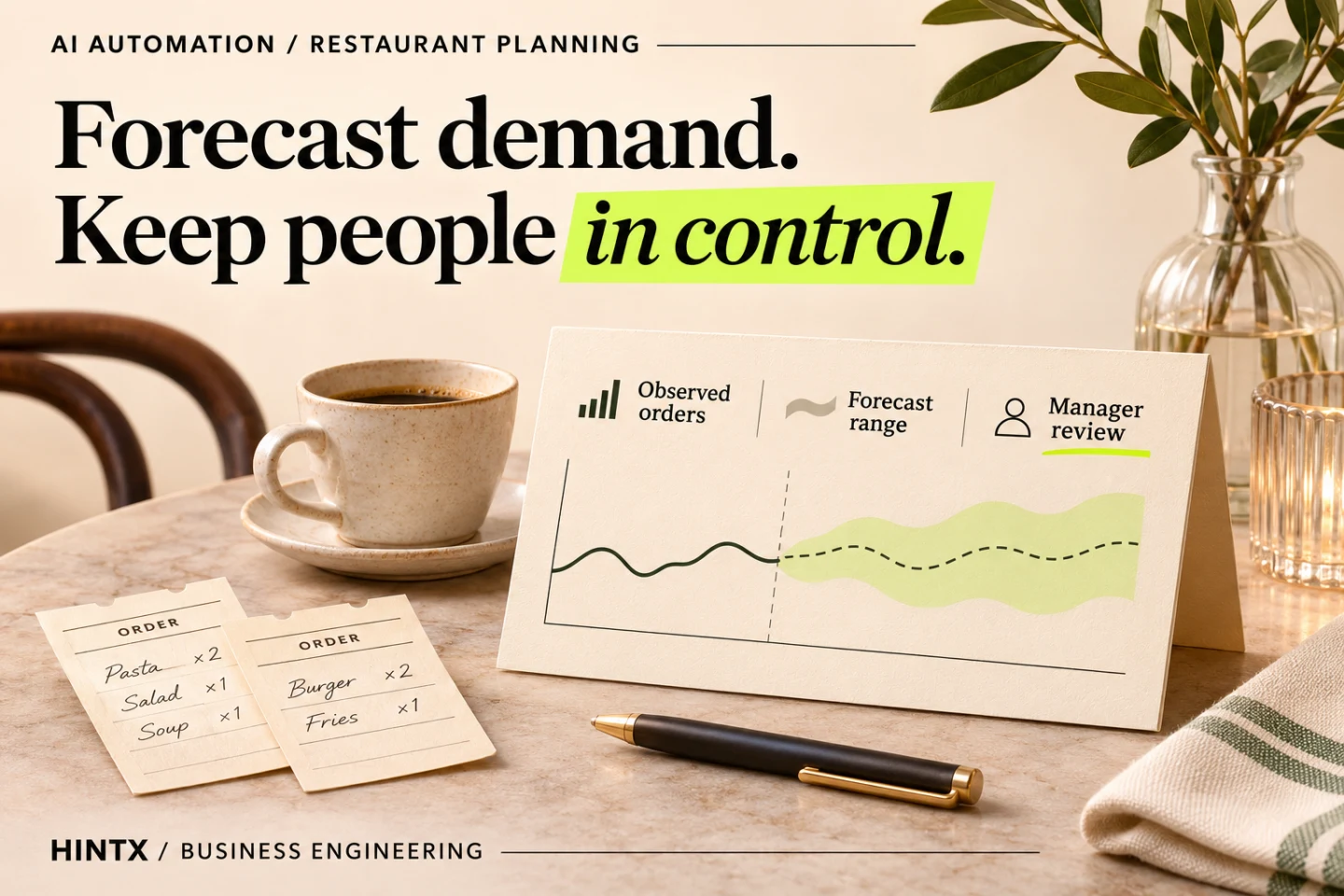
AI demand forecasting can support restaurant planning when the underlying order data is reliable and managers can review the recommendations. Begin with a specific planning decision, a simple baseline and a test against later observed demand.
Choose the decision before choosing the model
A restaurant may want to estimate tomorrow's drink demand, plan purchasing for a weekend or understand differences between locations. These are separate forecasting tasks. Each has a different time horizon, unit and consequence when the estimate is wrong. “Predict sales” is too vague to guide an implementation.
Define the output in business terms. For example: expected units of a product group at one branch during the next trading day, with a range and a manager review step. Keep the recommendation separate from an automatic purchase order. A forecast is an estimate, not permission to spend or a guarantee that stock will be used.
What POS data can and cannot tell you
Completed sales show what was purchased under the conditions that existed. They do not reveal every customer who wanted an unavailable item. A sold-out product may record low sales despite strong demand. Closed trading hours, cancelled orders and menu changes can also distort the history if they are treated as ordinary observations.
Build a data dictionary before modelling. Record what each status means, how refunds and cancellations are handled, which timezone defines the trading day and whether a product identifier remains stable across menu revisions. Separate a genuine zero from missing data. A connection outage should not teach the model that the branch had no demand.
| Input | Check before using it | Planning implication |
|---|---|---|
| Order and line-item records | Stable identifiers, timestamps, quantities and final states | A consistent definition of observed sales |
| Branch and trading calendar | Opening hours, closures and comparable trading periods | Location-specific context |
| Menu and availability | Product changes, substitutions and stockouts | Low sales may not mean low demand |
| Known future events | Only information available when the plan is made | Avoid testing with knowledge from the future |
| Manager decisions | Overrides and the reason for each change | A record of how the forecast was actually used |
Compare with a simple baseline
Before investing in a complex model, establish a transparent comparison such as the previous comparable trading day or a recent same-weekday average. Choose the baseline to fit the business and document its limitations. The new approach should earn its place by performing usefully on later periods, including busy days and quieter locations.
Microsoft's forecasting-methods overview distinguishes models based on past target values from models that also use explanatory inputs. For a restaurant, a practical implication is that future inputs must actually be available when the forecast is made. A promotion calendar may be known in advance; tomorrow's completed orders are not.
A language model can explain an approved planning result or summarise exceptions. It should not be treated as a substitute for a forecasting model simply because it can produce confident numbers in a conversation. Keep the numerical calculation, source data and explanation traceable.
Test as if you were making the decision then
Use earlier records to produce a forecast for a later period, then compare it with the later observations. Repeat this across several historical cut-off dates. Do not randomly mix future observations into training and then describe the result as a realistic forward-looking test.
Microsoft's forecasting evaluation guidance describes held-out testing and rolling evaluation over time. It also warns that recursively forecasting farther ahead can compound errors. These are reasons to evaluate the horizon your team actually needs, rather than assuming a successful next-day test supports a much longer purchasing plan.
Measure error by branch and product group as well as overall. A good total can hide consistently poor performance at one location. Examine underestimates and overestimates separately: the operational cost of missing demand may differ from the cost of excess purchasing. Agree the decision criteria with the operations team before selecting the preferred model.
A fictional pilot workflow
Imagine a cafe group piloting a next-day drink forecast at a small set of locations. Overnight, the system validates the latest completed orders, marks missing periods and creates a draft plan. The manager sees the estimate, its uncertainty, the comparison baseline and any unusual conditions. They accept or adjust it and record a short reason.
The first release does not automatically order supplies or decide preparation quantities. Those actions may depend on recipe definitions, stock on hand, supplier lead times and existing operating procedures. If those inputs are missing, the recommendation should stop at a reviewable demand estimate. This example is a proposed workflow, not a claim about an existing HINTX client deployment.
When a source feed fails, display the age of the last usable data and withhold an unsupported new forecast. Do not replace missing values with zeros merely to keep the dashboard looking complete. Keep the previous plan available with its original timestamp and a clear explanation of the gap.
Connect forecasting to an accountable operation
Assign an owner for data quality, a manager for the planning decision and a technical owner for failures. Review overrides to understand whether the forecast lacks useful context or whether the workflow itself is difficult to use. An ignored recommendation has not improved operations simply because a model produced it.
HINTX's A Cafe project and OKA project illustrate connected ordering and operational interfaces. They are relevant examples of the software context; this article does not claim that either project includes a deployed demand-forecasting system or a measured reduction in waste.
For related foundations, see multi-location menu and availability automation and POS reconciliation. Those guides address consistent source systems. Forecasting is a separate decision layer built on dependable records.
Frequently asked questions
How much historical data is enough?
There is no universal minimum. It depends on the forecast horizon, seasonality, product turnover and data quality. Test whether the available history supports a useful comparison before promising a result.
Can the system place supplier orders automatically?
That is a separate workflow requiring stock, purchasing rules, permissions and approval controls. Start with reviewable recommendations and verify the additional dependencies before expanding.
Does a more accurate forecast guarantee lower waste?
No. Outcomes also depend on purchasing and operating decisions. Measure observed waste or service outcomes separately using consistent definitions; do not infer them from model accuracy alone.
Assess your restaurant data first
HINTX builds business automation and connected operational software. Tell us which planning decision needs improvement, the systems holding your data and who will review the recommendation. We can help define a bounded feasibility test.
The cover is an editorial illustration, not a client dashboard or measured business result.



Login to comment
To post a comment, you must be logged in. Please login. Login
Comments (0)